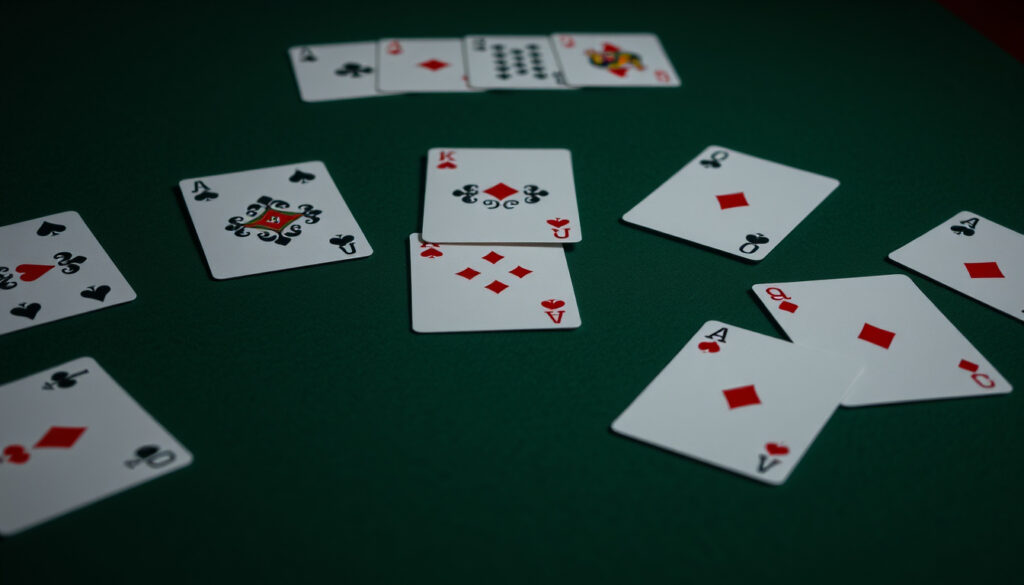
Patience (Game): Rules, How to Play & Strategies
There’s a paradox at the heart of Patience: everyone knows the game, yet most people who sit down with a deck lose more often than they win. The win rate for players using optimal strategy sits at roughly 30-40%, according to game analysts — a number that surprises many who assume the game is purely a luck-based exercise. This guide walks through the standard Klondike layout, the rules that govern each move, proven strategies that actually shift the odds in your favor, and a few historical notes on why figures like Winston Churchill kept a deck nearby during wartime.
Players: 1 · Deck: 52 cards · Origin: Europe, 18th century · Variants: Klondike, Spider, FreeCell · Win Rate: 30-40% with optimal play
Quick snapshot
- Patience uses a standard 52-card deck without jokers (Wikibooks)
- The game aims to build four foundation piles sorted by suit from Ace to King (52-card deck without jokers)
- Americans typically call the game Solitaire; British players still use the name Patience (52-card deck without jokers)
- Exact invention date — most sources point to late 1700s Europe but pinpointing the first game remains difficult
- Whether Klondike was Churchill’s most-played variant or one of several solitaires he preferred
- Playing cards first appeared in 12th-century China; reached Europe by the 14th century
- Patience games likely originated in Germany or Scandinavia in the late 1700s
- Digital Patience arrived with Microsoft Solitaire in 1990
- Free online implementations continue to introduce new players to the game
- Competitive digital formats and leaderboard systems are expanding the community
The key facts table below summarizes the essential parameters that define Patience gameplay.
| Field | Value |
|---|---|
| Game Type | Solitaire/Patience |
| Players | 1 |
| Deck Size | 52 cards |
| Objective | Sort all cards to foundations |
| Difficulty | Medium |
How do you play the game Patience?
Setup
Shuffle the deck thoroughly. Deal seven face-down columns, placing cards from the left so that the first column has 1 card, the second has 2, and so on — the seventh column holds 7 cards. After dealing the initial layout, flip the top card of each column face-up. The remaining cards form the stock pile, which you draw from during play.
Gameplay steps
The objective is to move all cards to four foundation piles, one per suit, building each from Ace to King. Draw the top card from the stock pile to the waste pile, then decide whether to move the exposed card to a foundation pile or a tableau column. Cards in tableau columns must follow a descending rank sequence while alternating colors — a red 6 on a black 7, for example. Move face-up cards between tableau columns to reveal hidden cards beneath.
Winning conditions
The game is won when all 52 cards have been moved to the four foundation piles, each sorted by suit in ascending order. If no legal moves remain and the stock pile is exhausted, the round ends in a loss. Players may also cycle through the stock pile by drawing three cards at a time and returning to the deck when no useful moves are available.
What is the layout of the Patience card game?
Tableau piles
The tableau consists of seven columns of varying depth. The first column holds one card face-up, the second holds two cards with the top card face-up, and this pattern continues so that the seventh column has seven cards with six face-down and one face-up. Only the face-up cards in each column are playable at any given moment.
Stock and waste
The stock pile contains the cards not placed in the tableau during setup. Players draw the top card to the waste pile and may use whichever card is face-up in the waste pile for their next move. Once the stock is empty, players may cycle through the waste pile by reversing the order of the three-card batches drawn.
Foundation piles
Four foundation piles sit above the tableau — one for each suit. Players place a single Ace on each pile to start. From there, each foundation builds in ascending rank: Ace, 2, 3, and so on up to King. The game is won when all four foundations are complete.
Is there a strategy to winning patience?
Key moves
Moving cards between tableau columns requires alternating colors in descending rank. Players can only place Kings on empty tableau spaces. Draw from the stock pile before passing a turn if no legal moves exist. Moving any face-up card in the tableau may open access to a hidden card beneath it, which is often the most valuable move available.
Common mistakes
Rushing to clear the stock pile prematurely limits future options. Moving low cards to foundation piles too early can leave mid-range cards stranded with no place to go. Filling empty tableau spaces with non-King cards wastes strategic positioning.
Advanced tips
Start each game by identifying all Aces on the tableau and moving them to foundation piles immediately. Preserve empty tableau spaces — only fill them with Kings or high-card sequences starting with Kings. When stuck, draw from the stock pile rather than forcing a suboptimal move. Focus on uncovering hidden cards in the tableau before building individual columns too far.
What was Winston Churchill’s favorite card game?
Winston Churchill was known for enjoying card games, though historical records indicate his favorites were games like bezique rather than strictly Patience or Klondike Solitaire. According to documented accounts, he played various forms of solitaire during wartime, finding the mental engagement and solitary focus valuable during long stretches between meetings and decisions. His interest in strategic card games reflected a broader pattern in his personality — a preference for activities that demanded calculation and patience under pressure.
Churchill’s documented preference was for games like bezique, and whether Klondike Patience was among his regular games remains uncertain in the historical record.
Churchill’s habits
Churchill was known to keep a deck of cards nearby during wartime, using solitaire games as a form of mental engagement during long hours of strategic planning. His documented preferences centered on bezique and similar games requiring two-player or multi-player setups, though solitary variations were reportedly part of his routine as well.
Patience connection
The connection between Churchill and Patience games appears largely indirect — a shared appreciation for methodical thinking and calculated risk that both the game and his political career demanded. Game historians note that his engagement with cards reflects a broader pattern of using strategic play to sharpen focus between major decisions.
Is solitaire a good brain exercise?
Patience engages multiple cognitive skills simultaneously — players must recognize card patterns, plan sequences several moves ahead, and adapt when new cards change the board state. Research on card game cognition suggests that games requiring strategic sequencing and working memory may offer more mental engagement than purely reactive gameplay. The mental exercise involved in Patience comes from the constant need to evaluate options and anticipate how current moves affect future card availability.
Unlike chess, where the opponent’s moves are fully visible, Patience forces players to make decisions under uncertainty — a cognitive challenge that demands flexibility rather than pure calculation.
Cognitive benefits
Pattern recognition, strategic planning, and working memory all come into play during a typical Patience game. Players must constantly evaluate which moves open up future options while building toward the foundation pile goal. The game requires sustained focus across multiple turns, which may contribute to the mental engagement reported by regular players.
Challenges involved
The inherent uncertainty in Patience — not knowing which cards will appear from the stock pile — sets it apart from games with complete information. Each draw changes the board state, requiring players to recalculate and adapt rather than execute a pre-planned sequence. This uncertainty is what makes winning difficult and contributes to the game’s estimated 30-40% win rate even among skilled players.
Is Patience luck or skill?
The answer is both — and the balance shifts based on how the cards fall. A well-shuffled deck means that roughly 30-40% of games are technically winnable under optimal play, according to analysis from game-strategy publications. Skilled players consistently outperform random play by avoiding moves that close off future options and by recognizing when to cycle through the stock pile rather than forcing suboptimal placements. The game rewards pattern recognition and long-term planning, but the random distribution of cards means that even strong players face unwinnable layouts on a regular basis.
The most consistent players understand that Patience is won through decision quality, not outcome chasing — and accept the roughly 70% of games that no sequence of moves could save.
How can you improve at Patience card game?
Improvement at Patience comes from developing sharper pattern recognition and learning to evaluate each position based on potential outcomes rather than immediate gains. Players who advance most quickly tend to replay games they lose, analyzing where a different sequence of moves might have led to victory. Study the tableau before making the first move — identify all Aces,
More related posts
 New Zealand KiwiSaver Changes 2025-2026: Rates, Dates Explained
 Hunting and Fishing Pukekohe: Hours, Phone & Address
 How Many Episodes in Handmaid’s Tale Season 6? Final Season
 Road Closures Today Taranaki North: Current Info & Tools
 Kaipo Olsen-Baker Injury: Ankle Recovery & World Cup
 New World Victoria Park Fire Details – Timeline, Facts and Updates
 How Many Seconds Are in a Day? Exact Answer
 Apex Car Rental Auckland: Honest Review & Guide