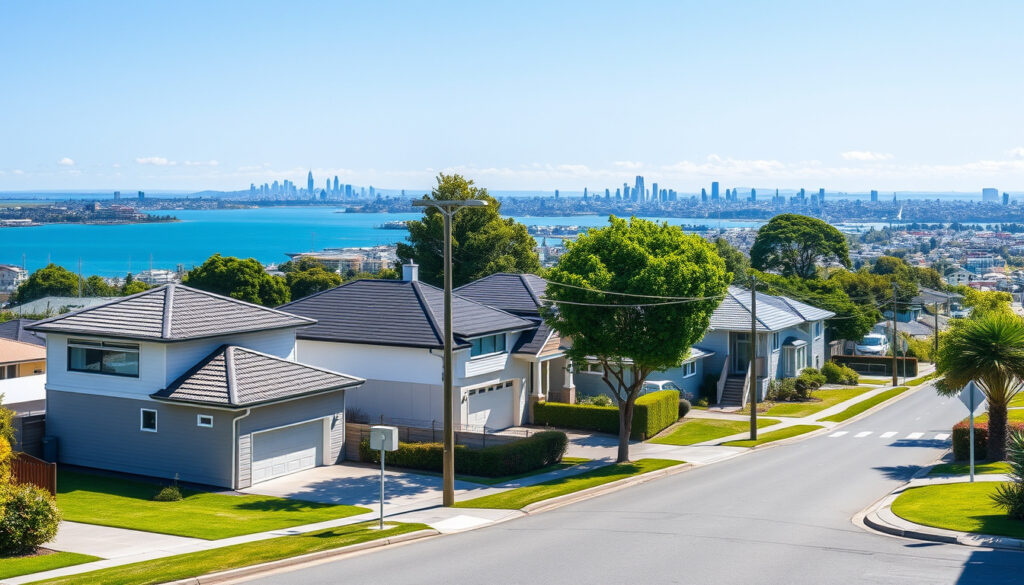
Homes for Sale in Auckland NZ 2025: Prices & Guide
If you’ve been watching Auckland’s property market from the sidelines, you’re not alone. The city’s housing landscape has shifted since the peak of 2021, and 2025 brings a mix of lower prices and tighter rules that make buying both more accessible and more complicated.
Median house value (Auckland Region, June 2025): NZ$1,232,340 (QV) ·
Year-on-year change: -1.4% ·
Foreign buyer restriction: Non-residents generally cannot buy existing homes (LINZ)
Quick snapshot
- Papakura and Franklin: NZ$750,000–$875,000 (MoneyHub)
- Waitakere and Manukau: NZ$885,000–$985,000 (MoneyHub)
- Auckland Central: NZ$475,700 average (Opes Partners)
- Cheapest suburb: Auckland Central at NZ$475,700
- Most expensive: Herne Bay at NZ$3,011,600
The table below summarises the core market figures every buyer needs in one place.
| Metric | Value | Source |
|---|---|---|
| Median house value (Auckland Region, June 2025) | NZD 1,232,340 | QV |
| Annual price change (June 2024–2025) | -1.4% | QV |
| Foreign buyer rule | Non-residents cannot buy existing homes | LINZ |
| Cheapest suburb median (Papakura) | Approx. NZD 750,000 | MoneyHub |
| Most expensive suburb (Herne Bay) | NZD 3,011,600 | Opes Partners |
| Price vs 2021 peak | 18.8% lower | QV |
What is the average cost of a home in Auckland?
Median house price by district
Six districts, one pattern: the median price varies by more than NZ$2.5 million from the most affordable to the most expensive. According to MoneyHub (personal finance guide), North Shore and Auckland City sit above NZ$1.1 million, while Papakura and Franklin fall in the NZ$750,000–$875,000 range. Waitakere and Manukau land between NZ$885,000 and NZ$985,000.
The district differences reflect the market’s segmentation. Buyers targeting homes for sale in Auckland NZ under NZ$800,000 will find the most options in the southern and western suburbs, while central and coastal areas remain premium.
Price per square meter trends
In central Auckland, Opes Partners (property investment analysts) report that the average house value is NZ$475,700 — the lowest in the region — but that reflects the prevalence of apartments and smaller units. In suburbs like Ponsonby and Devonport, price per square meter can exceed NZ$10,000.
The catch: lower per-square-meter costs in outer suburbs come with longer commutes. The trade-off between space and location is sharper in Auckland than in most other New Zealand cities.
A buyer with NZ$800,000 can get a three-bedroom house in Papakura or a one-bedroom apartment in Ponsonby. The choice defines not just your mortgage but your lifestyle and daily commute.
Can foreigners buy property in Auckland?
Can I buy a house if I am not a resident?
Under the Land Information New Zealand (LINZ) guidance, overseas people usually cannot buy existing residential property unless they meet specific residency or exemption rules. To qualify as an “ordinarily resident” buyer, a person must hold a residence class visa, have lived in New Zealand for at least the last 12 months, and be tax resident by being personally present for more than 183 days in that period.
Exceptions exist for Australian and Singaporean citizens, who are treated the same as New Zealand residents. New builds remain open to foreign buyers, a significant loophole for those looking at off-plan homes.
What are the exceptions for Australian and Singaporean buyers?
Under the LINZ policy, Australian and Singaporean citizens are exempt from the overseas buyer ban, meaning they can purchase existing homes without special consent. All other non-residents must apply for pre-approval, which can last up to one year.
In late 2025, a law change reported by Lane Neave (legal advisory firm) opened a pathway for Active Investor Plus visa holders, Investor 1, and Investor 2 visa holders to buy or build one home in New Zealand — but only for properties valued above NZ$5 million and subject to Overseas Investment Office consent. This affects a very narrow slice of the market.
If you’re a foreigner eyeing homes for sale in Auckland NZ, focus on new developments and builds. The existing-home market is effectively closed, and the NZ$5 million investor path is only for the ultra-wealthy.
The implication: for 99% of foreign buyers, the rule is simple — buy new, or don’t buy. This restriction has reshaped Auckland’s new-build sector and kept existing-home demand from overseas muted.
Where is the cheapest place to buy a house in Auckland?
What is the nicest suburb of Auckland?
Ponsonby, Devonport, and Takapuna frequently top “best suburb” lists for their cafes, beaches, and proximity to the city. But “nice” comes at a price. Opes Partners lists Herne Bay as the most expensive suburb in Auckland at NZ$3,011,600 average — more than six times the cost of the cheapest suburb, Auckland Central.
Top 7 most affordable Auckland suburbs
Seven suburbs, one pattern: all lie south or west of the city centre, where land is cheaper and housing stock includes older three-bedroom homes. Based on data from MoneyHub and Opes Partners, the most affordable suburbs (sorted by median price) are:
- Auckland Central — NZ$475,700 (apartment-heavy)
- Papakura — around NZ$750,000–$875,000
- Pukekohe — similar to Papakura
- Manurewa — slightly below Papakura
- Otara — among the lowest
- Mangere — near the airport
- Glen Innes — east but still affordable
For buyers searching for houses for sale in Auckland under $800,000, these suburbs are the realistic target zone. Transport links to the city are improving, with new train stations and busways cutting commute times.
Are house prices dropping in Auckland?
Year-on-year price change data
QV (property valuation firm) reports that Auckland Region home values were 1.0% lower in the June 2025 quarter and 1.4% lower than June 2024. The average value of NZ$1,232,340 is 18.8% below the national peak of late 2021. By October 2025, Goodwins (real estate agency) noted that the average dropped another NZ$23,000 to NZ$1.26 million, with three-quarters of suburbs seeing declines.
Forecast for 2025
Economists quoted by Goodwins predict a flat to slight decline for the rest of 2025, with interest rates and net migration the key drivers. The market appears to be stabilising after the sharp correction from 2021–2024, but there is no consensus on when a recovery will start.
A Facebook group post (tier-3 source) claimed Auckland’s median price rose to NZ$978,000 in July 2025 — but this data is not corroborated by QV or REINZ. Rely on official indices for your buying decision.
Why this matters: for anyone looking at homes for sale in Auckland NZ as an investment, the downward trend means you may be buying at a lower point — but the possibility of further declines means timing is everything. Buyers should not expect rapid appreciation in 2025.
How much do you need to earn to live comfortably in Auckland?
What salary do you need to live comfortably?
Mortgage repayments on a median-priced home require roughly NZ$1,000 per week, according to industry estimates. To afford that plus other living costs, a household income of NZ$120,000+ is often suggested, though exact figures depend on debt levels, family size, and lifestyle. MoneyHub notes that Auckland’s cost of living is the highest in New Zealand, with rents, groceries, and transport all above the national average.
Household income vs mortgage affordability
Using the current median value of NZ$1,232,340 and a 20% deposit, a 30-year mortgage at 6.5% interest would cost around NZ$1,200 per week. Lenders typically require a stable income and a debt-to-income ratio below 7x. For a single buyer, that means a salary of at least NZ$150,000 is needed to qualify comfortably. For a dual-income household, NZ$120,000 combined is the baseline.
Is it cheaper to live in NZ or Australia?
Cost of living comparison: Auckland vs Sydney
Four categories, one pattern: housing is cheaper in Auckland than in Sydney, but wages in Australia are higher. According to MoneyHub (consumer finance resource), New Zealand has lower grocery and utility costs, while Australia’s higher salaries offset the housing gap for many migrants.
| Category | Auckland | Sydney |
|---|---|---|
| Median house value | NZ$1,232,340 | ~AUD 1,450,000 (~NZ$1,550,000) |
| Average weekly rent (2-bed apartment) | NZ$650 | AUD 750 (NZ$800) |
| Groceries (monthly, family of 4) | NZ$1,100 | AUD 1,300 (NZ$1,390) |
| Average full-time wage | NZ$75,000 | AUD 100,000 (NZ$107,000) |
Data for Sydney sourced from general market reports; Auckland data from QV, MoneyHub, and Opes Partners.
For a household earning NZ$150,000, buying a median-priced home in Auckland is tight but possible. In Sydney, that same household would struggle to afford a median home. The difference is real.
Pros and cons of buying in Auckland in 2025
Upsides
- Prices are 18.8% below the 2021 peak, offering a better entry point than in recent years (QV)
- Affordable suburbs in the south and west provide options under NZ$800,000 (MoneyHub)
- New builds are accessible to foreign buyers, expanding the market (LINZ)
- Interest rates are stabilising after a period of increases
Downsides
- High mortgage costs require a household income of NZ$120,000+ for comfort
- Foreign buyer restrictions limit the pool of buyers for existing homes (LINZ)
- Prices are still falling in many suburbs, creating uncertainty about future value (Goodwins)
- Commuting from affordable suburbs can be time-consuming and expensive
Timeline of Auckland housing market shifts
- 2018 — Overseas Investment Amendment Act restricts foreign buyers of existing homes (LINZ)
- 2021 — Auction median house price peaks at NZ$1,200,000; national market peaks (QV)
- 2024 — Prices begin declining; interest rates rise; couples sell at a loss (reported by Goodwins)
- Early 2025 — Median price NZ$1,232,340; market stabilising but still soft (QV)
- Late 2025 (Dec) — Law change allows Active Investor Plus visa holders to buy homes over NZ$5 million (Lane Neave)
Clarity check: what’s confirmed and what’s unclear
Confirmed facts
- Foreign buyers cannot purchase existing homes (exceptions apply) — LINZ
- Median house price in Auckland is around NZ$1,232,340 — QV
More related posts
 1 oz to Grams: Standard vs Troy Ounce Weight Explained
 TV Guide New Zealand – Access Free and Paid Schedules
 Most Awarded Pie in NZ: Rosedale’s 2025 Supreme Win
 Hunting and Fishing Pukekohe: Hours, Phone & Address
 Best Power and Broadband Deals Ireland: Compare Bundles
 iPhone 13 Pro: Worth Buying? Price, Support & Availability
 Robert Galbraith Book in Order: Complete Cormoran Strike Serie
 South Africa National Cricket Team: History, Stats & FAQs