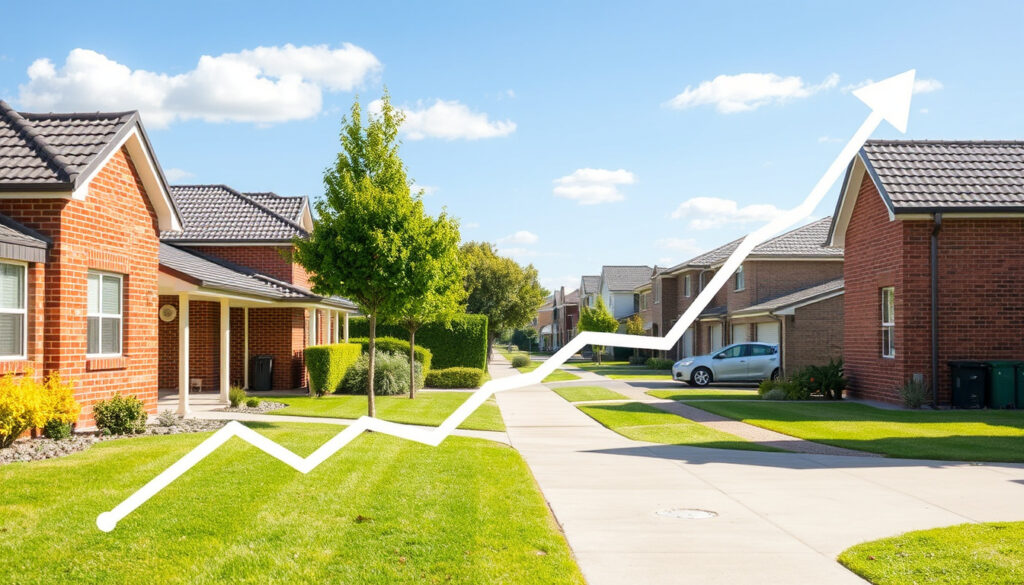
ANZ Bank House Price Forecast 2026: 2% Growth Predicted
ANZ economists have slashed their 2026 NZ house price forecast three times in four months—from an initial 5% growth projection to a potential 2% decline—citing weak domestic momentum and escalating Middle East tensions. Here’s what the latest ANZ Property Focus reports actually say about regional divergences, mortgage rate pressures, and what it means for homeowners and investors tracking the NZ property market.
ANZ 2026 house price inflation forecast: 2% (reduced from 5%) · ANZ expected house price change this year: 2% drop · Middle East conflict cited as factor: Yes · Reserve Bank 2026 forecast: 0.03% growth
Quick snapshot
- ANZ cut 2026 forecast to 2% growth from initial 5% (Interest.co.nz)
- ANZ later pencilled in -2% for 2026 citing Middle East conflict (1News)
- Wellington prices down 4% in six months as of January 2026 (ANZ Property Focus Jan 2026)
- How much the Middle East conflict will actually impact NZ property
- Whether mortgage rates will drop to 3% again in 2026
- Exact timing and magnitude of the next OCR move
- Late 2025: ANZ initially forecast 5% growth for 2026
- March 2026: First downgrade to 2% in Property Focus report
- March 2026: ANZ confirms downgrade, REINZ index down
- March 2026: Second revision to -2% citing geopolitical tensions
- OCR expected to rise late 2026, adding pressure to house prices
- Election uncertainty in 2026 could further dampen market confidence
- Regional divergence likely to continue through 2026
Key figures from ANZ’s Property Focus reports and third-party analysts reveal how the bank’s forecasts have shifted alongside changing market conditions.
| Metric | Value | Source |
|---|---|---|
| ANZ 2026 forecast revised | 2% house price inflation | Interest.co.nz |
| Prior ANZ forecast | 5% | ANZ Property Focus |
| Expected drop this year | 2% (ANZ Property Focus) | 1News |
| Reserve Bank forecast | 0.03% to Dec 2026 | Opes Partners |
| Wellington prices | Down 4% vs 6 months prior | ANZ Property Focus Jan 2026 |
| House prices flat duration | 3 years (as of Jan 2026) | ANZ Property Focus Jan 2026 |
| ANZ housing loans | $114 billion (Sep 2025) | Interest.co.nz |
Will NZ house prices go up in 2026?
ANZ economists have dialled back their optimism significantly. After initially predicting 5% house price inflation for 2026, the bank revised its forecast to just 2% growth in March 2026, citing weak market momentum and flat prices stretching back three years (ANZ Property Focus Jan 2026). Then in March 2026, ANZ went further—pencilling in a 2% price decline for the full year, blaming escalating Middle East tensions for adding fresh uncertainty to the economic outlook (1News).
ANZ’s latest 2026 forecast
The March 2026 Property Focus report marked ANZ’s most significant downgrade in recent memory. “Weighing it all up, we have reduced our house price inflation forecast for 2026 to 2% (from 5% previously),” the bank’s economists stated (ANZ Property Focus Jan 2026). The March 2026 report confirmed this downgrade, noting that soft January data—including a declining REINZ house price index—supported the cautious stance (ANZ Property Focus Feb 2026). February did bring an unexpected bright spot: house prices rose 0.6% that month on an ANZ-adjusted basis, though economists cautioned this was likely a blip rather than a trend reversal.
Factors like Middle East conflict
Beyond domestic headwinds, ANZ economists flagged geopolitical risk as a new variable. The Middle East conflict, they argued, introduces global economic uncertainty that could further depress consumer confidence and housing demand (1News). Domestically, low net migration—driven by high departures to Australia—continues to pressure demand, while the prospect of OCR rises in late 2026 adds further weight against price growth (ANZ Property Focus Jan 2026). Election uncertainty later in 2026 compounds these challenges.
Regional divergence within NZ
The national picture masks sharp regional splits. Wellington prices dropped roughly 4% compared to six months prior, weighed down by population outflows and slower development activity (ANZ Property Focus Jan 2026). Auckland prices are drifting down too, though at a slower pace than Wellington, with an oversupply of townhouses and undersupply of standalone homes creating divergent price pressures across property types (MoneyHub NZ). In contrast, Canterbury, Otago, and Southland continued posting price gains as of March 2026, supported by stronger regional economies and more balanced supply-demand dynamics (ANZ Property Focus Jan 2026).
What is the 5 year forecast for mortgage rates?
Longer-term mortgage rate forecasting in New Zealand remains a murky exercise. ANZ’s economists have consistently pointed to the gap between rental yields and mortgage costs as a key constraint on house prices, noting that longer-term rates “are still high relative to rental yields, suggesting little impetus for prices to rise” (Interest.co.nz). The bank hasn’t published a detailed 5-year mortgage rate forecast, but its Property Focus reports provide contextual signals through OCR expectations.
ANZ-linked rate outlook
ANZ’s March 2026 Property Focus report anticipated the next OCR move would be upward, occurring in late 2026 (ANZ Property Focus Jan 2026). This OCR increase would translate into higher floating and short-term fixed mortgage rates, adding pressure to already stretched borrowing costs. Interest.co.nz has reported that further mortgage rate increases remain a risk, warning that borrowers should prepare for potential hikes rather than expecting relief (Interest.co.nz).
Longer-term predictions
No bank has published a formal 5-year mortgage rate forecast in recent ANZ Property Focus reports. The Reserve Bank’s February 2026 Monetary Policy Statement (MPS) projects a modest 0.03% house price rise to December 2026, suggesting the central bank sees limited rate-driven price pressure in the near term (Opes Partners). The median bank forecast sits at 0.00% change to December 2026, positioning the industry collectively as cautious but not bearish (Opes Partners). Beyond 2026, RMA reforms—which could reduce compliance costs by 45%—may eventually boost housing supply and moderate price growth, though this remains a longer-term structural factor.
The OCR direction in late 2026 will be the clearest signal for mortgage rate movements. If ANZ’s forecast of rising OCR holds, borrowers on floating or short-term fixes should prepare for increased costs rather than expecting relief.
Will Mortgage Rates Go Down in 2026?
For homeowners hoping for relief on mortgage costs, the 2026 outlook offers little comfort. ANZ economists have not signalled rate cuts in their Property Focus reports, instead flagging the prospect of rising OCR as a headwind for house prices (ANZ Property Focus Feb 2026). Interest.co.nz analysis similarly warns that further mortgage rate increases remain a distinct possibility rather than a distant risk (Interest.co.nz).
Predictions for lows
The idea of mortgage rates dropping back to 3% appears increasingly unlikely for 2026. Longer-term rates—those offered on 5-year and 10-year terms—remain elevated relative to rental yields, making property investment less attractive on a yield basis (Interest.co.nz). This spread between borrowing costs and rental returns effectively limits the room for rate-driven price growth. With ANZ and the Reserve Bank both pointing to potential OCR increases in late 2026, those lows may be further away than some borrowers hope.
Borrowers expecting mortgage rates to fall back to pandemic-era lows in 2026 are likely to be disappointed. ANZ’s economic signals point toward elevated rates for the foreseeable future, with the next move more likely up than down.
Should I fix for 3 or 5 years?
Choosing a fixed mortgage term requires weighing current rates against future uncertainty—and 2026 presents an unusually complex trade-off. With ANZ predicting potential OCR increases in late 2026, fixing for longer terms could lock in rates before they rise further. However, the bank’s muted house price outlook means property owners may face a slower path to equity gains regardless of financing costs.
Pros and cons of terms
Upsides
- Longer fixes (5-10 years) protect against anticipated OCR rises in late 2026
- Fixed rates currently above 3% signal stability, reducing payment uncertainty
- Locking in now avoids the risk of chasing higher rates if ANZ’s OCR forecast materialises
- Property investors benefit from rental income predictability when costs are fixed
Downsides
- Longer fixed terms carry higher interest rate premiums upfront
- If OCR falls unexpectedly, borrowers on 5-10 year terms miss out on savings
- Flexibility penalties apply if circumstances change during a long fix
- With house prices potentially flat or declining, equity gains may not offset financing costs
Current rate environment
The current environment reflects ANZ’s broader cautious outlook. With house prices effectively flat for three years and regional markets diverging sharply, borrowers face a different calculus than the post-pandemic recovery years. Longer-term mortgage rates remain elevated relative to rental yields, meaning the carry cost of holding property outweighs income returns for many investors (Interest.co.nz). For owner-occupiers, the decision centres on stability versus flexibility—particularly given the late 2026 OCR uncertainty ANZ has flagged.
Is ANZ a buy, hold, or sell?
For investors considering ANZ shares, the bank’s muted property outlook creates a nuanced picture. ANZ New Zealand reported $114 billion in total housing loans as of September 30, 2025, making it one of the country’s largest mortgage lenders (Interest.co.nz). A softening housing market could affect loan growth, default rates, and ultimately shareholder returns—but the relationship isn’t straightforward.
Valuation assessment
Bank stock valuations typically respond to net interest margin trends, asset quality, and growth prospects. With OCR expected to rise in late 2026, ANZ may benefit from wider margins on new lending, potentially offsetting slower loan growth in a flat property market. However, a prolonged house price decline could increase mortgage stress and provisions, weighing on profitability. As of early 2026, Investing.com analysis shows ANZ shares under pressure as markets digest the revised -2% house price forecast (MPA Magazine).
Overvalued risks
MoneyHub NZ has flagged that bank house price forecasts have historically been unreliable, with 2025 predictions of 7-10% growth proving significantly overstated (MoneyHub NZ). For ANZ stock specifically, the risk lies in whether the bank’s revised forecasts accurately predict reality—if property prices fall more sharply than expected, the bank’s mortgage book faces greater asset quality risk. Conversely, if the bank’s economists are too pessimistic, the stock may be trading below fair value on a medium-term view.
ANZ’s property gloom doesn’t automatically signal a bad investment. Rising OCR could widen margins on new lending even as loan volumes stagnate. Investors should watch net interest margins and mortgage arrears trends closely rather than reacting to headline forecast revisions alone.
ANZ NZ House Price Forecast Timeline
Three distinct forecast revisions mark ANZ’s evolving view of 2026 property markets, each reflecting new data or shifting global circumstances.
| Period | Event | Source |
|---|---|---|
| Late 2025 | ANZ initially forecast 5% house price growth for 2026 | ANZ Property Focus |
| March 2026 | ANZ revises to 2% growth; cites flat prices and soft demand | ANZ Property Focus Jan 2026 |
| March 2026 | REINZ house price index edges down; confirms weak start | ANZ Property Focus Feb 2026 |
| March 2026 | ANZ confirms January downgrade; flags OCR headwinds | ANZ Property Focus Feb 2026 |
| March 2026 | Reserve Bank projects 0.03% house price growth to Dec 2026 | Opes Partners |
| March 2026 | ANZ revises again to -2%, citing Middle East conflict impact | 1News |
ANZ has revised its 2026 forecast down three times since late 2025, suggesting the bank is actively recalibrating rather than holding a fixed view.
What We Know vs What We Don’t
Sorting confirmed facts from lingering uncertainties helps separate signal from noise in ANZ’s forecast landscape.
Confirmed facts
- ANZ revised 2026 house price forecast to 2% from initial 5% (January 2026)
- ANZ later pencilled in -2% decline citing Middle East conflict (January 2026)
- House prices flat for three years as of January 2026
- Wellington prices down 4% vs prior six months
- OCR expected to rise in late 2026
- ANZ housing loan book totalled $114 billion (January 2026)
What’s unclear
- Exact magnitude of Middle East conflict’s impact on NZ property
- Whether mortgage rates will fall back toward 3%
- 5-year house price trajectory beyond 2026
- Whether ANZ’s revised -2% forecast will prove accurate or too pessimistic
- Quantitative net migration figures and their precise market impact
“Bank economists are predicting modest house price growth of 2-5% for 2026. However, these forecasts have been consistently wrong.”
MoneyHub NZ analysis (MoneyHub NZ)
“Longer term mortgage rates are still high relative to rental yields, suggesting little impetus for prices to rise.”
ANZ economists, NZ Property Focus (Interest.co.nz)
Related reading: ANZ Smart ATM Near Me · Compare Term Deposit Rates NZ
This ANZ projection echoes caution across NZ lenders, as seen in ASBs revised forecast predicting flat growth for house prices in 2026.
Frequently asked questions
What factors are driving ANZ’s house price forecast revisions?
ANZ’s economists have cited multiple factors: three years of flat house prices, low net migration driven by departures to Australia, elevated mortgage rates relative to rental yields, and the prospect of OCR increases in late 2026. The March 2026 revision added Middle East geopolitical tensions as a new variable affecting global economic confidence.
How does Westpac’s forecast compare to ANZ?
Westpac’s specific 2026 house price forecast details were not included in the ANZ Property Focus reports cited. The Reserve Bank’s February 2026 Monetary Policy Statement projected a 0.03% house price rise to March 2026, notably more pessimistic than ANZ’s initial 2% forecast. The median bank forecast sits at 0.00%, placing ANZ slightly above average but still cautious.
What are NZ house price predictions for 2027?
ANZ Property Focus reports cited do not include specific 2027 forecasts. The bank’s focus remains on 2026, with analysts noting that recovery beyond 2026 depends on OCR direction, migration trends, and global economic conditions. Property market observers should monitor subsequent quarterly reports for 2027 outlooks.
Will house prices rebound after 2026?
ANZ’s Property Focus reports suggest any recovery would likely be gradual and rate-dependent. If OCR rises in late 2026 as forecast, higher borrowing costs may continue suppressing demand into early 2027. Structural factors like RMA reforms (potentially reducing compliance costs by 45%) could eventually boost supply and moderate prices, but timing remains uncertain.
What impacts Auckland house prices per ANZ?
According to ANZ’s March 2026 Property Focus report, Auckland house prices are drifting down but at a slower pace than Wellington. The market faces mixed signals: oversupply of townhouses contrasts with undersupply of standalone homes, creating divergent price pressures across property types. The town’s oversupply situation suggests price growth for standalone houses may outpace apartments in the medium term.
Is now a good time to invest in NZ property?
ANZ’s muted house price outlook—flat for three years with potential 2% decline in 2026—suggests capital gains are unlikely in the near term. For investors, rental yields remain under pressure as longer-term mortgage rates stay high relative to returns. Those buying for long-term holdings may find value in Auckland’s standalone homes, which remain undersupplied, while Wellington presents more risk given declining prices and population outflows.
How do global events affect ANZ forecasts?
ANZ’s March 2026 revision explicitly cited Middle East conflict as a factor prompting a shift from 2% growth to -2% decline for 2026. The bank argued that geopolitical tensions introduce global economic uncertainty that could further depress consumer confidence and housing demand in New Zealand. This marks a notable expansion of ANZ’s analytical framework to include external shocks alongside domestic factors.
For Auckland homeowners tracking ANZ’s forecasts, the message is clear: the bank’s economists see little near-term catalyst for price appreciation, and the Middle East conflict adds fresh downside risk. The path forward depends on whether OCR rises as expected in late 2026, how long Wellington’s correction lasts, and whether Canterbury’s regional strength spreads to other markets.
More related posts
 Dunedin School & Supermarket Break-In: Teen Arrested
 Things to Do in Wellington New Zealand: 2-3 Day Guide
 Aria on Bank Dunedin: 4.5-Star Motel Guide
 2025 Exam Timetable: Key Dates for Leaving Cert & University
 Spanish Night Classes in Auckland: Best Evening Courses & Schools
 Are Shops Open Easter Sunday 2026? UK, Ireland & NZ Laws
 iPhone 17 Pro Max Colours: Which Finish to Pick
 What Does a Heart Attack Feel Like – Symptoms in Men and Women