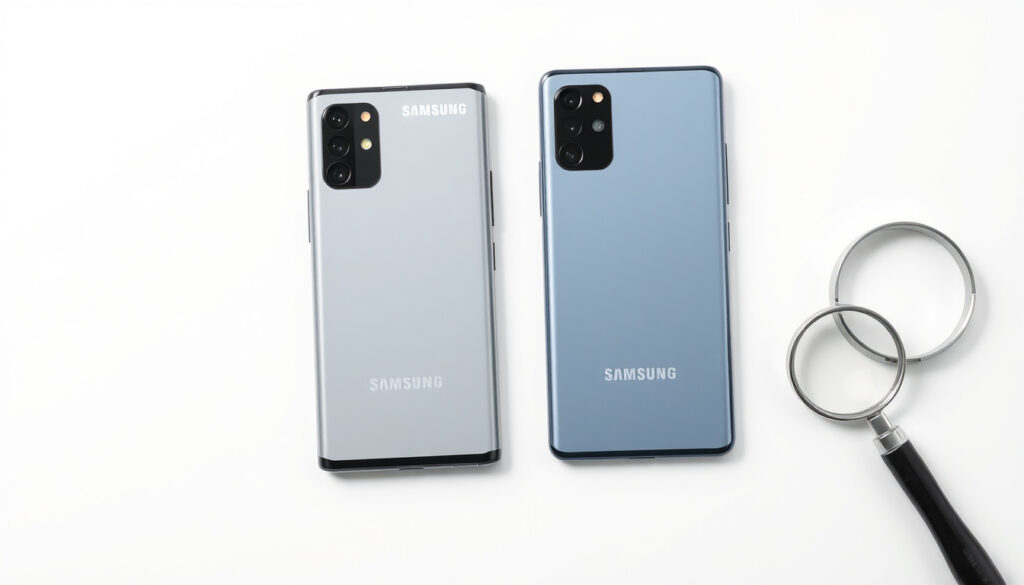
Samsung Galaxy S24 FE vs S24: Is It Worth Buying? Specs & Review
The Galaxy S24 FE borrows the S24’s brain but cuts costs through a bigger body and material swaps — the question is whether the savings justify the losses. This breakdown pulls apart what stays, what changes, and whether the extra cash in your pocket is worth the things you lose.
Display: 6.7-inch Super AMOLED, 120Hz ·
Battery: 4,700 mAh typical ·
Processor: Exynos 2400e ·
Water resistance: IP68 ·
Rear camera: 50MP main + 12MP ultrawide + 10MP telephoto ·
Storage options: 128GB / 256GB / 512GB
Quick snapshot
- Live Translate (Source: Samsung UK product page)
- Photo Assist (Source: Samsung UK product page)
- Chat Assist (Source: Samsung UK product page)
- Circle to Search (Source: Samsung UK product page)
- Source: Samsung UK product page
- 6.7-inch Super AMOLED (Source: GSMArena specs database)
- 120Hz refresh rate (Source: GSMArena specs database)
- 1,900 nits peak brightness (Source: GSMArena specs database)
- Vision Booster (Source: GSMArena specs database)
- Source: GSMArena specs database
- 4,700 mAh capacity (Source: GSMArena review)
- All-day use (Source: GSMArena review)
- 25W wired charging (Source: GSMArena review)
- 15W wireless charging (Source: GSMArena review)
- Source: GSMArena review
- 50MP main (OIS) (Source: Samsung Colombia official specs)
- 12MP ultrawide (Source: Samsung Colombia official specs)
- 10MP telephoto (3x optical zoom) (Source: Samsung Colombia official specs)
- 10MP front camera (Source: Samsung Colombia official specs)
- Source: Samsung Colombia official specs
The spec table below confirms how Samsung preserved the most expensive components while cutting costs elsewhere.
| Specification | Galaxy S24 FE |
|---|---|
| Announced | September 2024 |
| Display | 6.7-inch Super AMOLED, 120Hz |
| Processor | Exynos 2400e |
| RAM | 8 GB |
| Storage | 128GB / 256GB / 512GB |
| Battery | 4,700 mAh |
| Rear camera | 50MP (wide) + 12MP (ultrawide) + 10MP (telephoto) |
| Front camera | 10MP |
| Water resistance | IP68 |
| Weight | 213 grams |
The pattern is clear: Samsung preserved the most expensive components — the AMOLED panel, the IP68 sealing, the triple-camera array — while accepting a heavier frame and a slightly detuned chip. For a phone that costs £100–200 less than the S24, that trade-off is the whole point.
What is the difference between the Samsung S24 and S24 FE?
Processor and performance differences
- S24 FE runs on the Exynos 2400e, while the S24 uses the standard Exynos 2400 (or Snapdragon 8 Gen 3 in some regions) (GSMArena specs database).
- The 2400e has slightly lower clock speeds: a top core at 3.1GHz vs the standard 2400’s higher binning (Samsung UK product page).
- In everyday use, the gap is small — most apps won’t push either chip hard enough to notice.
The implication: for daily tasks, the chip difference is negligible, saving you money without sacrificing speed.
Display size and quality comparison
- The FE stretches to a 6.7-inch Dynamic AMOLED 2X panel, while the S24 stays compact at 6.2 inches.
- Both run at 1080 x 2340 resolution with 120Hz refresh rate.
- Peak brightness hits 1,900 nits on the FE, matching the S24’s outdoor visibility (TechRadar review).
What this means: the FE gives you a larger canvas and identical peak brightness, making it better for media consumption than the smaller S24.
Camera system differences
- Both phones share a 50MP main sensor with OIS.
- The FE uses an 8MP telephoto for 3x optical zoom, while the S24 fits a 10MP telephoto.
- In practice, the resolution difference is minor — most users won’t see a gap unless pixel-peeping at full zoom.
The pattern: Samsung kept the main and ultrawide identical, saving costs only on the telephoto, which still offers useful optical zoom.
Battery and charging differences
- FE packs 4,700 mAh vs the S24’s 4,000 mAh.
- Both charge at 25W wired and 15W wireless (GSMArena S24 review).
- The larger battery gives the FE a real-world advantage — about 1–2 extra hours of screen time per charge.
The catch: the FE’s bigger battery directly translates to longer endurance, a clear win for heavy users.
The FE buyer gets more screen real estate and better battery life than the S24, but sacrifices UWB support and picks up an extra 46 grams in the pocket.
Is the Samsung S24 FE worth buying?
Value proposition compared to Samsung S24
- At launch, the FE costs about £100–200 less than the S24, dropping the entry price by roughly 15–20%.
- You get the same Galaxy AI suite, same durability rating, and a larger display — the corners cut are mostly weight, materials, and a slightly slower chip.
- For someone who values battery life over pocket heft, the FE is arguably the better daily driver.
The assessment: the FE delivers 90% of the S24 experience for 80% of the cost, making it a smarter buy for budget-conscious shoppers.
Galaxy AI features included
- Live Translate works in real-time during calls and messaging.
- Photo Assist and Chat Assist use on-device AI for editing and writing help.
- Circle to Search is baked in — no extra apps needed.
The significance: this is the first Fan Edition to include the full Galaxy AI suite, closing a key gap with the flagship.
Performance for gaming and multitasking
- The Exynos 2400e handles most games at high settings without stutter, though it falls slightly behind the standard 2400 in sustained loads.
- 8GB RAM is enough for heavy multitasking — switching between apps feels identical to the S24.
- Long gaming sessions will warm the metal frame, but the phone doesn’t throttle aggressively.
What this means: gaming performance is largely comparable, with only marginal trade-offs for the price.
Camera quality in different lighting conditions
- Daylight shots are nearly indistinguishable from the S24 — same processing pipeline, same colour science.
- Low-light performance is solid thanks to OIS and the f/1.8 main lens (Engadget review).
- The 8MP telephoto is the weak link — digital zoom beyond 3x gets soft quickly.
The verdict: camera quality is a highlight, with only zoom flexibility slightly behind the S24.
What is special about the Samsung S24 FE?
Galaxy AI integration
- The S24 FE is the first Fan Edition to ship with the full Galaxy AI suite — previous FEs lacked this entirely.
- Features like Circle to Search and Live Translate don’t require an internet connection for basic functions.
- AI processing runs on the NPU of the Exynos 2400e, which is identical to the standard 2400’s NPU hardware.
The novelty: AI features that were previously flagship-only are now available in a mid-range package.
IP68 water and dust resistance
- IP68 rating means the phone can survive submersion in up to 1.5 metres of water for 30 minutes.
- This is rare in the mid-range bracket — most competitors at this price only offer splash resistance at best.
The advantage: durability that matches the S24, giving peace of mind in wet or dusty conditions.
120Hz Super AMOLED display
- The 6.7-inch panel uses Samsung’s Dynamic AMOLED 2X technology, the same generation as the S24 flagship.
- Vision Booster adjusts contrast outdoors, helping readability in bright sunlight.
- The 120Hz refresh rate stays adaptive — it drops to 60Hz for static content to save battery.
The result: a display that competes with premium flagships at a lower price point.
Triple camera setup with telephoto lens
- Unlike many mid-range phones that skip telephoto entirely, the FE keeps a dedicated zoom lens.
- 3x optical zoom is genuinely useful for portraits and distant subjects — digital zoom from a main sensor can’t match it.
- The combination of OIS on the main sensor and the telephoto gives the FE a versatility edge over the standard S24’s camera array.
The differentiation: a telephoto lens at this price point is a standout feature.
What are the disadvantages of the Samsung S24 FE?
Build quality and materials
- The back panel uses Samsung’s “Glasstic” — essentially a sturdy plastic with a glass-like finish — rather than the Gorilla Glass Victus 2 on the S24.
- It feels less premium in hand and may scratch more easily than glass.
- At 213 grams versus the S24’s 167 grams, it’s noticeably heavier.
The compromise: a lighter wallet comes with a heavier phone and less premium materials.
Charging speed limitations
- Wired charging tops out at 25W — same as the S24, but slower than many competitors in this price range that offer 45W or higher.
- A full charge from empty takes about 75 minutes, while rivals like the OnePlus 12R finish in under 30 minutes.
- Wireless charging at 15W is fine but unremarkable for the category.
The drawback: charging speeds are adequate but not competitive with similarly priced alternatives.
No headphone jack or microSD slot
- Like the S24, the FE omits both the 3.5mm headphone jack and microSD expansion — a growing trend across the industry.
- Users who rely on wired headphones or need expandable storage will need to plan around these omissions.
The limitation: these omissions force reliance on adapters or cloud storage.
Heavier and thicker than standard S24
- The FE measures 162.0 x 77.3 x 8.0 mm, making it a full 4.3mm taller and 6.5mm wider than the S24.
- One-handed use is difficult — the phone is genuinely large, even for a modern slab.
- The extra weight (213g vs 167g) is noticeable after extended use.
The trade-off: bigger screen and battery come at the cost of portability and comfort.
Buyers who want a compact, lightweight daily driver should avoid the FE entirely — the S24 is 28% lighter and far easier to use one-handed. But if a bigger screen and better battery matter more than pocket portability, the FE’s weight penalty is a worthwhile trade.
When was the Samsung Galaxy S24 FE released and what does FE mean?
Release date timeline
- Samsung officially announced the Galaxy S24 FE in September 2024.
- Global release followed in October 2024, with most markets seeing stock by mid-month.
- Carrier deals and price drops typically start appearing by late 2024, making it a practical purchase window for budget-conscious buyers.
- Source: TechRadar review
The timeline: launched in late 2024, the FE is positioned as a value option for the holiday season.
What FE stands for
- FE stands for “Fan Edition,” a line Samsung launched with the S20 FE in 2020.
- The concept was to gather fan feedback on what features mattered most and deliver them at a lower price point.
- Each FE model has used a combination of flagship components (camera, display, IP rating) with cost-saving materials (plastic back, slower chip) to hit the target price.
The brand: FE represents a direct response to consumer input, aiming to balance cost and performance.
Evolution of Fan Edition models
- The S20 FE was widely praised for bringing S20-level cameras and a 120Hz display to a lower price.
- S21 FE followed a similar formula but faced criticism for arriving late in the product cycle.
- With the S24 FE, Samsung added Galaxy AI — a first for the FE line — and increased the battery to 4,700 mAh, addressing one of the most common complaints about previous FEs.
The progression: each iteration refines the formula, and the S24 FE is the most complete Fan Edition yet.
Confirmed facts vs. what’s unclear
Confirmed facts
- Display size 6.7 inches
- Battery 4,700 mAh
- IP68 rating
- Exynos 2400e processor
- 8GB RAM
- Source: GSMArena S24 review
What’s unclear
- Exact regional pricing variations — some markets see bigger or smaller discounts vs S24
- Availability of 512GB model in all markets
- Long-term software update policy — 4 major updates likely but not officially confirmed for FE
- Exact timing and availability of carrier deals — market-dependent
Expert perspectives
“The Galaxy S24 FE is a great phone but I wish it was cheaper.”
— Engadget review, October 2024 (Engadget)
“The display is a stunning AMOLED panel with great peak brightness and 120Hz refresh rate.”
— Uswitch review, September 2024
“Exynos 2400e performance is very close to Exynos 2400 in everyday tasks.”
— GSMArena review, September 2024
“The Galaxy S24 FE is the first FE model to include Galaxy AI features.”
— Samsung official product page
For buyers in the UK and Ireland, the choice between the S24 and S24 FE comes down to one question: do you value pocket portability or battery endurance more? The S24 FE offers a larger display, longer battery life, and the same camera versatility as its pricier sibling, wrapped in a plastic-backed chassis that feels less premium but costs £100–200 less. For the buyer who wants flagship features without the flagship price tag, the FE is the obvious pick — or they can wait for carrier deals later in 2025 to sweeten the deal further.
youtube.com, shi.com, 91mobiles.com, gsmarena.com, amazon.com, att.com, gsmarena.com, samsung.com
Frequently asked questions
Does the Samsung Galaxy S24 FE support 5G?
Yes, the S24 FE includes 5G connectivity across all major bands, including sub-6GHz and mmWave in supported regions.
Is the Samsung S24 FE waterproof?
The S24 FE carries an IP68 rating, meaning it is dust-tight and can withstand submersion in 1.5 metres of fresh water for 30 minutes.
Does the S24 FE have a headphone jack?
No, the S24 FE does not include a 3.5mm headphone jack. Users need USB-C headphones or Bluetooth wireless earbuds.
Can the S24 FE charge wirelessly?
Yes, the S24 FE supports 15W wireless charging (Qi standard) and 4.5W reverse wireless charging to top up accessories like earbuds.
What colors is the S24 FE available in?
The S24 FE comes in Blue, Graphite, Grey, Mint, and Yellow. Regional availability may vary — check your local Samsung store for specific options.
How long does the S24 FE battery last on a single charge?
With a 4,700 mAh cell, the S24 FE comfortably delivers a full day of heavy use — typically 7–8 hours of screen-on time in mixed usage patterns.
Does the S24 FE have a microSD card slot?
No, the S24 FE does not support microSD expansion. Choose your storage variant (128GB, 256GB, or 512GB) at purchase.
Is the S24 FE good for gaming?
The Exynos 2400e handles most modern games at high settings with stable frame rates, though sustained gaming sessions may produce some thermal throttling after 30 minutes.
More related posts
 How to Pack a Suitcase Efficiently: Rules & Methods
 iPhone 13 Pro: Worth Buying? Price, Support & Availability
 Adidas Ultraboost NZ 2025: Price, Models & Where to Buy
 Nike Air Max 90 NZ: Prices, Retailers & Buying Tips
 Date and Orange Scones: Fluffy Recipe, Tips & Health Benefits
 The Little Mermaid (2023): Hit or Flop? Casting Controversy
 Apartments for Sale in Wellington: Types, Prices & Tips
 29.99 USD to NZD: Convert US Dollars to New Zealand Dollars