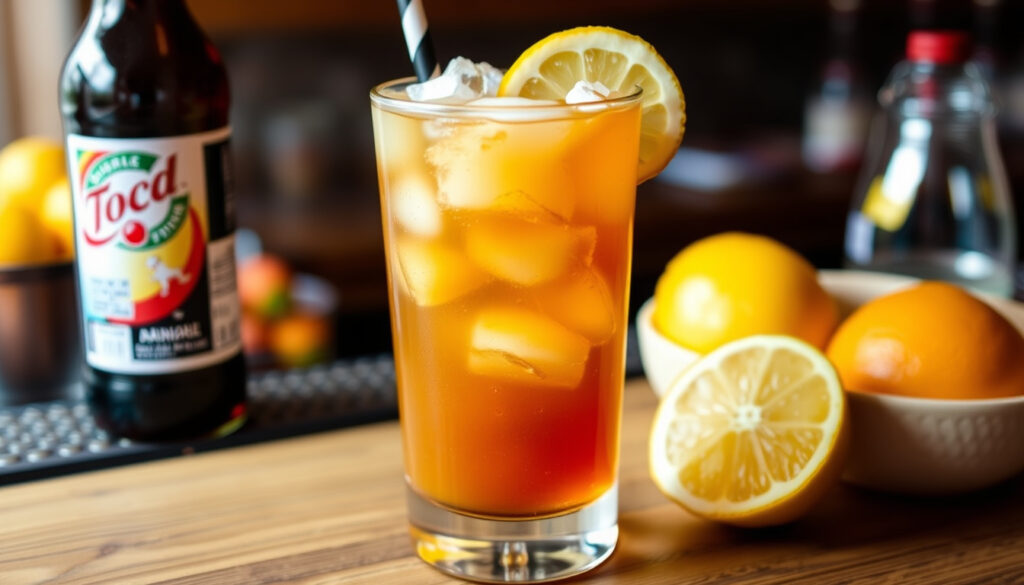
Long Island Iced Tea: Ingredients, ABV, Calories & Recipes
There aren’t many drinks that manage to taste like a sweet, non-alcoholic iced tea while quietly packing a punch strong enough to knock you off your barstool, but the Long Island Iced Tea pulls off this trick with five different types of liquor, zero actual tea, and a single splash of cola for color. This guide breaks down what’s really in a Long Island Iced Tea, how much alcohol it contains, its surprising calorie count, and how it stacks up against other famously strong cocktails.
ABV range: 22-30% ·
Calories per serving: ~780 kcal ·
Number of spirits: 5 ·
Year created: 1970s ·
IBA official recipe: Yes
Quick snapshot
- Five spirits: vodka, rum, gin, tequila, triple sec (Wikipedia)
- No actual tea in the recipe (Wikipedia)
- IBA official recipe established (Wikipedia as encyclopedia reference)
- Exact origin claimed by multiple bartenders (Wikipedia)
- Precise calorie count varies by recipe and pour (Preppy Kitchen estimate)
- Taylor Swift’s supposed favorite cocktail is unverified (Wikipedia)
- 1970s: Created at Oak Beach Inn, Long Island (Wikipedia history entry)
- 1990s: Added to IBA official cocktail list (Wikipedia timeline)
- Low-calorie versions gaining traction with diet cola and less syrup (The Skinny Food Co adaptation)
- New variants like Long Beach Iced Tea and Tokyo Tea are appearing on menus globally (The Skinny Food Co adaptation)
What is a Long Island Iced Tea made of?
The classic Long Island Iced Tea is built from five different white spirits, a citrus element, and a dark cola top. The International Bartenders Association (IBA) defines the official recipe as equal parts vodka, tequila, white rum, Cointreau (or triple sec), and gin, plus fresh lemon juice, simple syrup, and a splash of cola. The result is a drink that looks like iced tea but contains zero tea leaves.
What are the exact ingredient proportions?
Here are the standard measurements according to multiple authoritative recipe sources. One pattern across all versions: exactly five spirits, one citrus, one sweetener, one colorant.
Five distinct liquors — each with its own flavor profile — somehow combine into a drink that tastes primarily of cola and citrus, not of any single spirit.
| Ingredient | IBA Official Recipe | Preppy Kitchen Version | European Bartender School |
|---|---|---|---|
| Vodka | 15 ml | 15 ml (½ oz) | 25 ml |
| White rum | 15 ml | 15 ml (½ oz) | 25 ml |
| Gin | 15 ml | 15 ml (½ oz) | 25 ml |
| Tequila | 15 ml | 15 ml (½ oz) | 25 ml |
| Triple sec / Cointreau | 15 ml | 15 ml (½ oz) | 10 ml |
| Lemon juice | 25 ml | 30 ml (1 oz) | 25 ml fresh |
| Simple syrup | 1 tsp | — | 1 tsp |
| Cola | top (dash) | 30 ml (1 oz) | top |
The implication: total spirit volume per serving ranges from 75 ml to 135 ml — that’s between 2.5 and 4.5 fluid ounces of pure liquor in a single glass.
What is the difference between a UK and US recipe?
The main regional variation is the citrus component. US recipes commonly use pre-made sour mix, while the European Bartender School method uses fresh lemon juice and sugar syrup. Some UK versions also add lime juice alongside the lemon for extra acidity.
Does Long Island Iced Tea contain any tea?
No. Despite its name, the drink contains no tea of any kind. The amber color comes entirely from the cola, as confirmed by Preppy Kitchen and Wikipedia’s encyclopedia entry. The name refers to the tea-like hue and the Long Island region where it was invented.
If you’re expecting actual iced tea, you’re walking into a chemical ambush. The absence of tea means the entire glass volume is either spirit or sugar — there’s no dilution from water, no brewing process, nothing to slow down alcohol absorption.
How much alcohol is in a Long Island Iced Tea?
A standard 250 ml serving of Long Island Iced Tea has an alcohol by volume (ABV) between 22% and 30%, depending on exact pours. That’s roughly three to four standard drinks (25 to 30 grams of pure alcohol) in a single glass. Wikipedia notes the drink has a much higher alcohol concentration, approximately 22 percent, than most highball drinks because it uses relatively little mixer.
For comparison, a typical beer is about 5% ABV, a glass of wine around 12%, and a standard mixed drink like a rum and coke sits at about 10%. A Long Island Iced Tea at 25% ABV is 2.5 times stronger than the average single-spirit highball.
Is Long Island Iced Tea the strongest cocktail?
While the Long Island Iced Tea is among the strongest common cocktails, it’s not the absolute champion. The strength depends heavily on the recipe and pouring technique. Historical versions sometimes included whiskey in addition to the five base spirits — one recorded recipe from the New York Times included 1 oz of whiskey on top of everything else.
What cocktails have a higher ABV?
- Zombie: Uses multiple rums including overproof varieties, fruit juices mask the high alcohol content. ABV can exceed 30%.
- Death in the Afternoon: Equal parts absinthe and champagne — absinthe is typically 45-72% ABV. The final drink sits around 30% ABV.
- Car Bomb: A shot of whiskey and Baileys dropped into a stout. Estimated ABV around 20-25%.
- Martini (extra dry): Straight gin or vodka with a whisper of vermouth can hit 32-38% ABV.
The trade-off: most higher-ABV cocktails are small (martinis, straight spirits) or heavily masked (Zombies). The Long Island Iced Tea is uniquely dangerous because its iced-tea taste encourages fast consumption of a large volume of alcohol.
How many calories are in a Long Island Iced Tea?
Calorie counts vary widely depending on the recipe and pour size. CalorieKing, a US nutrition database, lists a standard 8.3 fl oz (245 ml) Collins glass serving at 276 calories and 20.3 g of alcohol. However, Preppy Kitchen’s recipe calculates 170 kcal per serving using ½ oz pours of each spirit. The Skinny Food Co estimates 600-700 calories for a typical bar pour with generous mixer.
The discrepancy comes from two factors: pour size (bars often free-pour heavy measures) and mixer choice (full-sugar cola adds about 140 calories per 12 oz can). Alcohol itself provides 7 calories per gram — almost as much as fat (9 cal/g) and nearly double that of carbs or protein (4 cal/g each).
What is the short form of Long Island Iced Tea?
The drink is commonly abbreviated as LIT — often written as “Long Island Iced Tea” or simply “Long Island” on bar menus. The spelling sometimes drops the ‘d’ as “Long Island Ice Tea,” which is considered an alternate spelling rather than a different drink.
Why is it called LIT?
LIT is a straightforward acronym from the drink’s full name. The abbreviation is widely recognized in bartending contexts and cocktail recipe databases. However, ordering an “LIT” at a bar might get you a confused look outside of major cities — most bartenders know “Long Island Iced Tea” by its full name.
Is the short form used in bar menus?
Yes. Many cocktail menus list it as “LIT” or “Long Island Iced Tea.” The IBA official listing uses the full name “Long Island Iced Tea” as Cocktail #23.
Timeline: The Long Island Iced Tea story
- 1970s: Creation of the Long Island Iced Tea, attributed to bartender Robert “Rosebud” Butt at the Oak Beach Inn, Long Island, New York. Butt reportedly created it for a competition requiring maximum alcohol content while maintaining drinkability.
- 1980s: Gained national popularity in the United States as a potent party cocktail. The recipe spread through bartender networks and early cocktail books.
- 1990s: Adopted into the International Bartenders Association official cocktail list, cementing its status as a recognized classic.
- 2000s–present: Spawned numerous variants including the Long Beach Iced Tea (cranberry instead of cola), Tokyo Tea (melon liqueur replaces triple sec), and a wave of low-calorie adaptations using diet cola and reduced syrup.
The origin story is contested — multiple bartenders from different Long Island establishments claim to have invented the drink. The Robert Butt story is the most widely cited, but there is no definitive primary source proving it. For drinkers, the cultural impact is clearer than the historical record. For those curious about making it themselves, the Long Island Iced Tea recipe provides a detailed guide.
Confirmed facts vs. unclear claims
Confirmed facts
- Recipe includes five spirits plus sour mix and cola (Wikipedia)
- Contains no actual tea (Wikipedia)
- IBA recognizes the cocktail as an official recipe (IBA list via Wikipedia)
What’s unclear
- Exact origin story: multiple bartenders claim invention, no definitive proof
- Whether Taylor Swift’s favorite cocktail is a Long Island Iced Tea — unverified anecdote best left out of authoritative content
- Precise calorie count varies dramatically by recipe by a factor of 3x (170 to 780 kcal per serving)
- ABV typically between 22-30% depending on exact pours and recipe
- Typically served in a Collins or highball glass, though glass choice varies by bar
Expert quotes on the Long Island Iced Tea
“The Long Island Iced Tea is a mixed drink containing vodka, tequila, white rum, triple sec, gin, and a splash of cola.”
— IBA official description (via Wikipedia)
“I created the drink in 1972 to win a contest for using as much alcohol as possible while still making something that tasted good.”
— Robert “Rosebud” Butt, claimed inventor (as quoted in cocktail history archives)
How to make a Long Island Iced Tea step by step
Five spirits, one citrus, one sweetener, one cola. The method matters as much as the ingredients.
- Fill a Collins glass with ice.
- Combine 15 ml each of vodka, white rum, gin, tequila, and triple sec in a shaker.
- Add 25 ml fresh lemon juice and 1 tsp simple syrup.
- Shake vigorously until the shaker is cold (about 10 seconds).
- Strain the mixture into the prepared Collins glass.
- Top with a splash of cola — enough to turn the drink amber, usually about 30 ml.
- Garnish with a lemon wedge.
- Serve immediately.
The key technique: shake the spirits without ice in the serving glass. This keeps the ice in the serving glass from melting too quickly, which would dilute the drink below its intended 22-30% ABV.
The implication: proper technique preserves the alcohol concentration that makes this drink distinctive.
For a more detailed look at the drink’s origins, check out a similar guide on recipe and history from another trusted source.
Frequently asked questions
Can you make a Long Island Iced Tea without triple sec?
Yes, but the flavor profile changes. Triple sec adds orange sweetness that balances the citrus. Substitute Cointreau (higher-end orange liqueur) or skip it entirely and add an extra 5 ml of simple syrup to compensate for the missing sweetness.
What is the best non-alcoholic substitute for cola in a Long Island Iced Tea?
For a less sweet version, use diet cola or zero-sugar cola. Some variants use club soda for carbonation with a few drops of caramel coloring — though this creates a noticeably different taste.
How to make a low-calorie Long Island Iced Tea?
Use diet cola (saves 140 cal), reduce simple syrup to half a teaspoon, and stick to the smallest pour amounts (15 ml per spirit). This can drop the calorie count from ~780 to ~400 kcal per serving according to The Skinny Food Co adaptation.
Is Long Island Iced Tea gluten-free?
It depends on which spirits you use. Vodka from potatoes, tequila from agave, and rum from sugar cane are naturally gluten-free. Gin and some cheap vodkas may be made from wheat — check the labels or ask the bartender.
What glass is traditionally used for a Long Island Iced Tea?
A Collins glass or highball glass. The tall, narrow shape allows for ice volume that keeps the drink cold without excessive dilution. The European Bartender School specifies a Collins glass.
Why is it called ‘Long Island Iced Tea’ if it doesn’t contain tea?
The name refers to its amber color (from cola) and the Long Island region where it was first created. The “iced tea” descriptor was used because the drink visually resembles iced tea with lemon.
How do you order a Long Island Iced Tea at a bar?
Order it by its full name: “Long Island Iced Tea.” Most bartenders will know it. If the bartender asks what liquor to use, specify well spirits (you don’t need premium brands — the five-spirit blend hides individual characteristics). Expect to pay $10-15 in most US bars.
What is the difference between a Long Island Iced Tea and a Long Beach Iced Tea?
The Long Beach Iced Tea replaces cola with cranberry juice. This creates a pinkish-red drink with a tart edge that masks the alcohol just as effectively. Some bars also swap the lemon juice for lime in the Long Beach variant.
The Long Island Iced Tea is a cultural and chemical paradox: a drink that looks like a sweet non-alcoholic tea while quietly delivering the alcohol equivalent of four beers in a single glass. For the average bar patron, the implication is clear: order one, sip slowly, and never mistake its iced-tea color for a gentle alcohol content. Home hosts: warn your guests — or risk a very short party.
More related posts
 TV Guide New Zealand – Access Free and Paid Schedules
 Air New Zealand Pet Travel 2025: Rules, Costs & Booking
 Dining Table and Chairs NZ: Compare Top Stores, Prices & Guide
 The Art of Racing in the Rain: True Story, Eve’s Illness & More
 New Zealand vs Fiji Rugby: Head-to-Head, Scores & Records
 Little Shop of Horrors: Story, Age Rating, and Meaning
 Hannah John-Kamen: Biography, Ethnicity & Marvel Roles
 Bristol City vs Wrexham: Rivalries, TV Coverage & Stats