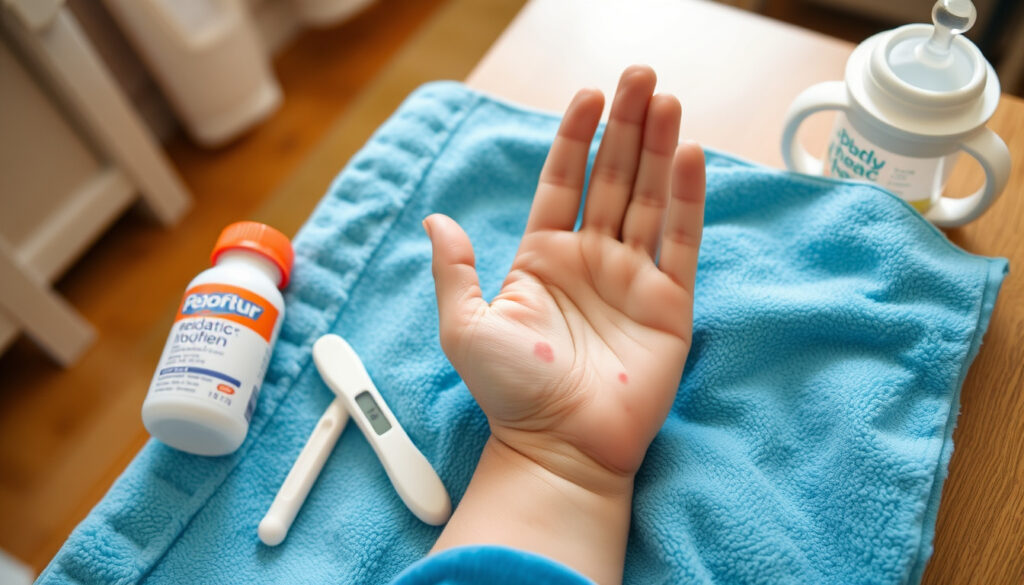
Hand, Foot and Mouth Disease Treatments: Parent Guide
Few things make a parent’s heart sink like seeing their little one break out in a blistery rash and struggle to swallow, yet hand, foot and mouth disease is common and there’s no quick fix. But knowing what you can do at home to ease the pain and keep your child hydrated makes a real difference, and here’s what top pediatric and public-health authorities actually say works.
Duration of illness: 7 to 10 days ·
Most common age group: Children under 5 years ·
Primary cause: Coxsackievirus A16 ·
Treatment approach: Supportive care, no antiviral ·
Contagious period: From symptom onset until blisters heal
Most people with HFMD get better on their own in 7 to 10 days.
— CDC
There’s no specific treatment for hand-foot-and-mouth disease.
— Mayo Clinic
Quick snapshot
- No specific antiviral treatment exists (CDC)
- Most cases resolve in 7–10 days (CDC)
- Acetaminophen and ibuprofen are safe for fever and pain (Mayo Clinic)
- Incubation 3–6 days; worst symptoms peak days 2–3
- Blisters crust over by day 7–10
- Focus on hydration and pain relief until blisters heal
- Quarantine until fever-free and blisters have dried
Six key facts, one pattern: every public-health authority agrees on supportive care—no antiviral, no magic cream—just good old symptom management. The table below lays out the essentials.
| Fact | Detail |
|---|---|
| Cause | Coxsackievirus A16 (most common) |
| Incubation | 3 to 6 days |
| Duration | 7 to 10 days |
| Treatment | Supportive care only |
| Contagious | Yes, from symptom onset |
The pattern is clear: no shortcuts, but plenty you can do to make the week tolerable. The next sections walk through exactly how.
What’s the best treatment for hand, foot and mouth disease?
Over-the-counter pain relief
- Acetaminophen or ibuprofen are the go-to options for reducing fever and easing the pain from mouth sores, according to the CDC (U.S. public-health agency).
- The Mayo Clinic (leading U.S. medical center) recommends cold drinks, ice pops, and soft foods alongside the medication.
- Aspirin should never be given to children with HFMD, warns the CDC.
Home remedies for itching and discomfort
- Cool fluids like water, milk, or oral rehydration solutions soothe the mouth, per NHS (U.K. national health authority).
- Soft foods such as yogurt, pudding, smoothies, and ice pops are safe bets, recommended by the Children’s Hospital of Philadelphia (top pediatric institution).
- For older children, warm salt-water rinses may provide relief, notes the Mayo Clinic.
- Avoid acidic foods—citrus fruits, fruit juices, and soda—which irritate mouth sores, according to Mayo Clinic and NHS.
When to see a doctor
- If your child cannot keep fluids down, has a fever lasting more than 3 days, or shows signs of dehydration (dry mouth, no tears, reduced urination), call your pediatrician.
- The CDC says severe cases are rare but require medical attention.
The implication: you’re not powerless, but you also don’t need to chase every folk remedy. Stick with what the science supports.
Parents face a specific challenge: mouth sores make children refuse drinks, which raises dehydration risk. The single most effective move is to treat pain so your child will drink—cold and soft wins.
Can you bathe a child with hand, foot and mouth disease?
Safe bathing practices
- Yes, bathing is safe and can help lower fever, confirms CDC.
- Use lukewarm water; hot water may irritate blisters and worsen discomfort.
- Pat skin dry gently—do not rub, as that can burst blisters.
Soothing irritated skin
- Calamine lotion or oatmeal baths may relieve itching, recommend pediatric sources like the Children’s Wisconsin (regional children’s hospital).
- Never burst blisters; they heal on their own and breaking them increases infection risk.
- Northwestern Medicine (Chicago-area health system) warns against exfoliation products on the rash—they slow healing.
The catch: bathing is helpful if done gently. The real danger is itching that leads to scratching and secondary infection. Calamine is your friend here.
How long should I stay away from people if I have hand, foot and mouth disease?
Duration of contagiousness
- The contagious period begins with symptom onset and lasts until blisters have dried and any fever has resolved—typically 7–10 days, per CDC.
- The virus can be shed in stool for weeks after symptoms clear, but the highest transmission risk is during the acute phase.
Quarantine guidelines for school and work
- Children should not attend daycare or school until fever is gone and blisters have crusted over, advises NHS.
- Adults should work from home if possible or avoid close contact—no hugging, kissing, or sharing utensils.
- Frequent handwashing and disinfecting high-touch surfaces reduce household spread, says CDC.
Why this matters: the standard “stay home until better” isn’t precise enough. For parents, the concrete benchmark is: no fever for 24 hours without medication, and blisters must be dry.
Adults who catch HFMD from their children often get milder symptoms, but the isolation clock still runs the same 7–10 days. Missing work is a real consequence, so plan ahead.
What’s the worst stage of hand, foot, and mouth?
Typical progression of symptoms
- Incubation: 3–6 days after exposure, with no symptoms.
- Days 1–3: fever (often 101–103°F), sore throat, reduced appetite.
- Days 2–4: rash appears—red spots on hands, feet, mouth, and sometimes buttocks, which may blister.
Signs of recovery
- Days 7–10: blisters crust over, fever resolves, appetite returns.
- The worst stage is typically days 2–3, when mouth sores are most painful and children may refuse all food and drink.
- Recovery usually begins around day 4–5, when pain starts receding.
The pattern: the peak misery is short—roughly 48 hours of intense mouth pain—but it feels endless for both child and parent. Knowing that relief typically arrives by day 4 can help families push through.
How likely are parents to get hand, foot, and mouth from their child?
Risk factors for adults
- Adults can contract HFMD—the CDC notes that symptoms are often milder than in children.
- Parents are at higher risk due to close contact: changing diapers, sharing food, hugging, and sleeping in proximity.
- Immunocompromised adults may experience more severe symptoms.
Preventing household spread
- Frequent handwashing with soap and water is the most effective preventive measure, per CDC.
- Disinfect surfaces—toys, doorknobs, countertops—with a bleach-based cleaner (coxsackievirus is resilient).
- Avoid sharing cups, towels, and utensils during the illness period.
- Adults who become infected may need to take time off work.
The trade-off: you can’t fully avoid exposure in close quarters, but you can cut viral load by consistent hygiene. Parents are likely to get it, but the silver lining is usually a milder course.
Upsides
- Most cases resolve without medical intervention in 7–10 days
- Pain relief options (acetaminophen, ibuprofen) are safe and widely available
- Home remedies like cold foods and calamine lotion genuinely help
- Children develop immunity to the specific virus after infection
Downsides
- No antiviral treatment speeds up recovery
- Mouth pain can lead to dehydration, especially in toddlers
- Coxsackievirus is highly contagious within households
- Adults often miss work while caring for sick children
- Vaccine is not available
pmc.ncbi.nlm.nih.gov, cityhealth.com, baby-chick.com, healthychildren.org, babynama.com
Frequently asked questions
Can hand, foot and mouth disease recur?
Yes. Because HFMD can be caused by different enteroviruses (like coxsackievirus A6 or A16), having it once doesn’t grant lifelong immunity. Recurrence is possible, though usually from a different strain.
Is there a vaccine for HFMD?
Not in the U.S. or Europe. A vaccine exists in China, but it targets only enterovirus 71, which is a less common cause.
Can adults get HFMD without symptoms?
Yes. Some adults who are infected never develop symptoms but can still shed the virus and spread it to others.
What disinfectants kill the coxsackievirus?
Bleach-based cleaners (diluted 1:10 with water) are effective. Alcohol-based hand sanitizers are less reliable against non-enveloped viruses like coxsackievirus—soap and water is preferred.
How is HFMD diagnosed?
Diagnosis is usually clinical—a doctor looks at the rash and mouth sores. Lab tests (PCR from throat swab or stool) are rarely needed except in outbreaks.
Can I use antibiotic cream on blisters?
No. Antibiotic creams are for bacterial infections, and HFMD is viral. They won’t help and may cause skin irritation.
Is HFMD dangerous for pregnant women?
Most cases in pregnancy are mild. If infection occurs close to delivery, there’s a small risk of passing the virus to the newborn. Pregnant women should contact their obstetrician if exposed.
For parents dealing with HFMD, the choice is clear: lean on supportive care—pain relief, hydration, and soft foods—and resist the urge to chase unproven remedies. The virus will run its course in a week, and knowing what actually works (and what doesn’t) makes the journey more manageable.
More related posts
 Chi Lewis-Parry: Age, Height, Career, and Personal Life
 2025 NZ Visitor Visa Fee: $341 Processing + $100 IVL
 How Many Seconds Are in a Day? Exact Answer
 When Does Winter End? Astronomical & Meteorological Dates
 Fenerbahçe vs Nottm Forest: Results, Stats & Live Updates
 Cars for Sale Invercargill: Used, Cheap, New Deals
 The Little Mermaid (2023): Hit or Flop? Casting Controversy