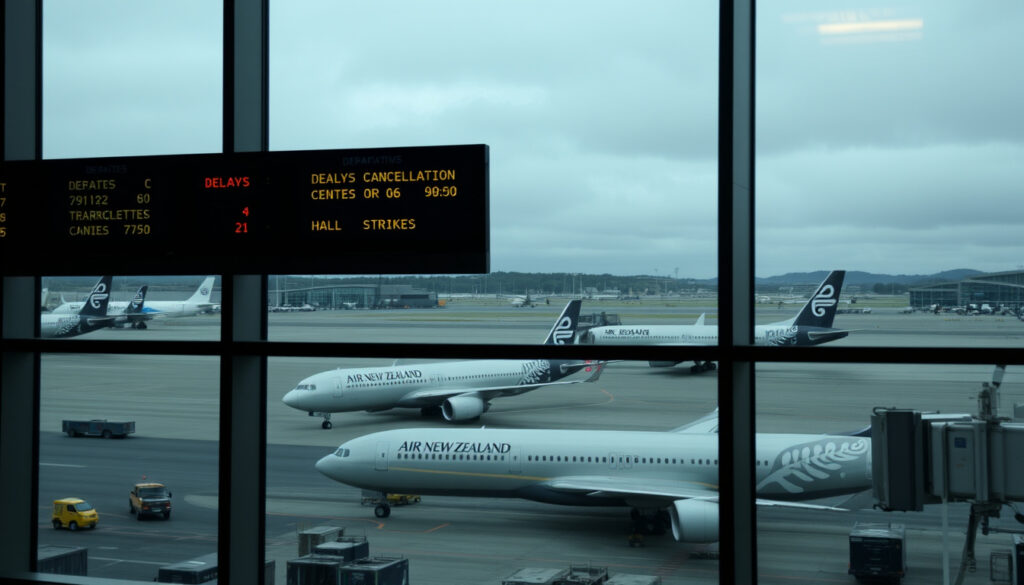
Air New Zealand Airport Tension: Strikes and Flight Disruptions
If you booked a long-haul flight out of Auckland recently, there’s a chance your trip didn’t go as planned. Air New Zealand cabin crew walked off the job for two days in mid-February, canceling dozens of widebody flights and leaving thousands of passengers scrambling for alternatives. The action wasn’t sudden — unions had to give 14 days’ notice under New Zealand law — but that didn’t make it any less disruptive for the 9,500-plus travelers caught in the middle.
First-half loss: $59 million · Strike reason: Failed negotiations · Fuel target cut: 30% at Auckland · Results date: Week of 22 Feb 2026
Quick snapshot
- 44–50 widebody flights cancelled Feb 12–13 (YouTube News)
- 9,500–16,000 passengers affected (AirTraveler.club)
- Air NZ offered 6.4% year-one pay increase (YouTube News)
- Exact final cancellation tally vs. early estimates
- Whether further strike action follows this round
- Resolution timeline for pay dispute
- Air NZ half-year results due week of 22 Feb 2026
- Continued re-accommodation via Star Alliance partners
- Ongoing contract talks between unions and management
| Detail | Data |
|---|---|
| Reported loss | $59m first-half |
| Strike involved | Cabin crew |
| Key airport | Auckland |
| Fuel target cut | 30% reduction |
| Results date | Week of 22 Feb 2026 |
| Cancelled flights | 44–50 widebody |
| Affected passengers | 9,500–16,000 |
| Pay offer (year 1) | 6.4% |
| Notice period required | 14 days |
Why are Air New Zealand flight attendants striking?
The E tū union and the Flight Attendants’ Association of New Zealand organized the action, centering the dispute on two issues: pay and roster stability. Cabin crew argued that Air New Zealand’s offer of up to 6.4% in year one — above inflation at the time — did not go far enough given post-pandemic workload pressures and irregular scheduling.
Unions rejected the airline’s proposal and pushed for stronger language around how rosters are built and maintained. The 14-day notice requirement under New Zealand employment law forced an early reveal: the strike notice was filed by January 28, 2026, giving the airline and passengers barely two weeks to prepare.
Strike causes
At the heart of the dispute is a pay-versus-workload mismatch that Air NZ management and union negotiators have struggled to bridge. The airline pointed to its above-inflation offer and improvements to conditions, while crews pointed to chronic post-pandemic scheduling problems as the real sticking point.
Current status
Bargaining resumed after the strike concluded, with both sides confirming more talks were scheduled for later in February 2026. No further strike action had been announced as of the week of February 22, though the underlying issues remained unresolved.
Is Air New Zealand in financial trouble?
Air New Zealand reported a first-half loss of $59 million, a figure that landed amid the industrial action. The airline has been scaling back operations in response to multiple pressures — including a stated target of cutting fuel uptake by 30% at Auckland — as it navigates a tough post-pandemic recovery while absorbing higher crew costs.
Air NZ half-year results were due to be released the week of February 22, 2026. The results will be watched closely as a test of whether the combination of strike disruption, operational scaling back, and cost pressures has deepened the financial hole the airline dug during the pandemic.
Recent losses
The $59 million first-half loss follows years of restructuring. The airline has been cutting capacity and renegotiating supplier contracts while attempting to rebuild international route revenue. The strike came at an inconvenient time — just ahead of what management hoped would be a clearer financial picture from the half-year report.
Upcoming results
Financial analysts tracking the airline will be looking for signals on whether the fuel uptake target is realistic and whether the pay negotiations will push costs higher. Any guidance on future route capacity out of Auckland will also be in focus, particularly for long-haul markets that depend on widebody aircraft like the Boeing 777 and 787.
What is the latest Air New Zealand strike update today?
The cabin crew strike wrapped on February 13, 2026, after two days of action that grounded nearly all of Air New Zealand’s widebody fleet. The airline’s official newsroom confirmed that teams worked through the night rebooking affected customers, with all 9,500 travelers contacted directly by the airline (Air NZ Newsroom).
Chief Customer Officer Jeremy O’Brien said the airline was providing 24/7 support for rebooking, with options spanning Star Alliance partner airlines, full refunds, and travel credits at no charge (AirTraveler.club). For passengers needing accommodation or meals due to extended delays, Air NZ committed to covering those costs as well.
Flight impacts
The strike knocked out essentially all long-haul flights from Auckland — routes to North America, Asia, and the Pacific relied on Boeing 777 and 787 aircraft staffed by the striking cabin crew. Domestic, Tasman, and Pacific Island services ran normally because they use narrowbody planes with different crew.
Cancelled flights list
Sources cited anywhere from 44 to 50 cancellations depending on how early estimates were cut off, with the AirHelp tally pointing to 44 long-haul flights confirmed cancelled (AirHelp). Among the specific routes affected: the Auckland-to-Taipei and Taipei-to-Auckland flights were cancelled on their respective days, with 600 travelers from Taiwan caught in the disruption — including 230 in tour groups traveling during Lunar New Year (Taipei Times).
What Air New Zealand cancelled flights are happening today?
For travelers asking about cancellations on any given day, the answer hinges on whether the flight uses widebody equipment. The strike was strictly a widebody action: any service operated by a Boeing 777 or 787 from Auckland was at risk. Narrowbody aircraft — used on domestic, Tasman, and Pacific Island routes — were unaffected and kept flying on schedule.
Domestic
Domestic flights within New Zealand ran normally throughout the strike period. Routes like Auckland–Wellington, Auckland–Christchurch, and similar services use Air NZ’s narrowbody fleet, which was protected by the scope of the strike notice.
International
Long-haul international routes bore the full impact. The 44–50 cancelled widebody flights covered services to Asia, North America, and other destinations that require Boeing 777 or 787 aircraft. Specific examples include the Auckland–Taipei and Taipei–Auckland flights, which were each cancelled on their respective days due to crew unavailability.
Auckland specific
Auckland Airport was the operational epicenter of the disruption. Long-haul departures from Auckland were either cancelled or retimed once the strike began. Passengers traveling through Auckland on connecting itineraries were also affected, particularly those whose inbound legs arrived from widebody services.
The strike was limited to widebody services, so if your Air NZ flight uses a narrowbody aircraft (common on Tasman and Pacific routes), it was almost certainly unaffected. Check the Air NZ arrivals and departures page for real-time status.
Is it safe to travel to New Zealand right now?
The strike was an operational disruption, not a safety event. Air New Zealand’s safety record remains intact, and the airline continues to operate its full domestic and regional network without interruption. For passengers holding tickets on affected long-haul flights, the issue is not safety — it’s schedule disruption.
The U.S. Department of State maintains standard travel advisories for New Zealand, and no additional warnings have been issued in connection with the labor dispute. As of February 2026, New Zealand was not under any elevated travel risk designation related to the strike.
Travel advisories
Government travel advisories from major source countries have not changed their New Zealand recommendations due to the Air NZ labor action. The disruption is classified as an airline operations issue, not a security or health concern.
Airline safety
Air New Zealand ranks among the world’s safer carriers by major safety indexes, and the strike had no bearing on maintenance, air traffic control, or crew certification. The narrowbody fleet that serves domestic routes has continued operating normally throughout the dispute.
Travelers should feel confident about safety when flying within New Zealand or on Tasman routes. The disruption is logistical, not operational — and rebooking options are more generous than many carriers offer.
Timeline
Three distinct phases mark this dispute: early bargaining, notice and cancellation buildup, and active strike followed by re-accommodation.
| Date | Event |
|---|---|
| January 28, 2026 | Strike notice filed by unions (earliest allowed under 14-day rule) |
| February 3, 2026 | Air NZ operational update confirms two-day strike scope |
| February 12, 2026 | Strike begins; 44–50 widebody flights cancelled from Auckland |
| February 13, 2026 | Strike second day; ongoing re-accommodation and rebooking |
| Later February 2026 | Further contract talks scheduled between Air NZ and unions |
The implication: the 14-day notice rule gave everyone — airline, passengers, and partner airlines — a narrow but workable window to prepare. Whether that notice period will be invoked again depends on how the next round of talks goes.
What we know — and what we don’t
The facts that can be confirmed are solid: the strike happened on February 12–13, 2026, roughly 44–50 widebody flights were cancelled, 9,500–16,000 passengers were affected, and the action was triggered by a rejected pay offer from Air NZ management.
What remains unclear is whether the pay dispute will produce further strike notices. No announcements had been confirmed as of late February 2026. The final cancellation count — whether closer to 44 or 50 — also varies slightly between sources, and the official Air NZ press release was not independently confirmed by a tier 1 source in the available research.
Confirmed
- Strike ran February 12–13, 2026
- 44–50 widebody flights cancelled
- 9,500–16,000 passengers impacted
- Air NZ offered 6.4% year-one pay increase
- Unions rejected the offer over workload and roster concerns
- All affected travelers contacted by Air NZ for rebooking
Unclear
- Whether further strike action will follow
- Exact final cancellation tally (44 vs 50)
- Whether pay negotiations will reach agreement in next round
- Long-term impact on Auckland long-haul route frequency
The strike exposed a gap between what Air NZ management offered and what cabin crew consider workable — a gap that hasn’t closed just because the picket lines came down.
What passengers are saying
For those impacted by cancellations today, our teams are working through rebooking options.
— Air New Zealand official statement (Air NZ Newsroom)
The airline is providing 24/7 support for rebooking.
— Jeremy O’Brien, Chief Customer Officer, Air New Zealand (AirTraveler.club)
Air New Zealand says it’s offered above inflation pay rises with more talk scheduled for later this month.
— Air New Zealand spokesperson (YouTube News)
One passenger, Dianna Bain, told NZ Herald she struggled to sort out bookings for her parents when the cancellations landed — a reminder that third-party bookings (made through travel agents or online aggregators) require extra steps to resolve (NZ Herald). Air NZ explicitly warned customers with agent bookings to check their status before the strike began.
If you booked through a third party, Air NZ’s direct rebooking tools may not handle your itinerary automatically — contact your travel agent first, then the airline.
For anyone rebooking, the window is wide: passengers can shift to a new date within seven days before or after their original booking without fees (Taipei Times). Those with longer lead times have more flexibility but should monitor the travel alerts page for updates as negotiations continue.
For travelers planning trips from New Zealand, the situation offers a clear lesson: widebody-dependent routes carry higher disruption risk during labor disputes. Domestic and Tasman services were untouched precisely because different aircraft and crew were involved. If your itinerary runs through Auckland on a Boeing 777 or 787, keep an eye on strike notices and check your booking status regularly.
Amid flight attendant strikes sparking widespread cancellations, travelers can check the Air NZ cancelled flights status for real-time updates at Auckland and key airports.
Frequently asked questions
How much does an Air NZ captain earn?
Air New Zealand captain salaries vary by experience and fleet type, with long-haul widebody captains typically earning more than narrowbody captains. Published industry estimates suggest captains on the 777 or 787 can earn well into the six figures, though exact figures are not publicly disclosed by the airline.
Which airline has the highest paid pilot?
Pilots at major Gulf carriers and U.S. legacy airlines often command the highest salaries globally, with seniority and aircraft type driving pay scales. Air New Zealand competes on regional terms, and its widebody captains are among the higher earners in the New Zealand market, though not at the top globally.
Do flight attendants work 40 hours a week?
Air New Zealand flight attendants typically work roster-based schedules tied to flight rosters, not a fixed 40-hour week. Actual hours vary with route assignments, layovers, and training days — and the union dispute centered partly on how irregular those rosters have become.
Why are people moving out of New Zealand?
Emigration from New Zealand has been driven by a mix of housing affordability pressures, cost of living, and career opportunities abroad. The trend predates the Air NZ strike and is not directly related to airline operations, though the aviation sector has faced its own staffing and retention challenges.
What does “yeah nah” mean in NZ?
“Yeah nah” is a casual New Zealand expression that typically means “no, but politely” or signals mild disagreement. It’s part of a broader set of distinctive Kiwi phrases that visitors sometimes find confusing but that carry genuine social warmth.
How do I rebook my Air NZ flight after a strike cancellation?
Air NZ rebooking is available via the Air NZ app, phone (1-800-262-1234), or by visiting the arrivals and departures page directly. Passengers can shift to a date within seven days before or after their original booking without change fees. If you booked through a travel agent, contact both the agent and Air NZ to ensure your itinerary is updated.
For passengers still in the rebooking process, the most practical move is to act quickly: seats on Star Alliance partners and alternative Air NZ flights tend to fill fast after cancellations. Those with flexibility on dates should jump on the seven-day rebooking window while it’s still open.
More related posts
 Best Stovetop Coffee Maker: Reviews & Buying Guide
 Best Double Sided Tape NZ: Strongest, Heavy Duty & Buying Guide
 Taylor Swift New Album – Release Date and Tracklist
 FIFA U-20 World Cup 2025: Winners, History, Schedule & Results
 Plan B Pill NZ – Where to Buy, Cost and Usage Guide
 Greenhaven Fish and Chips: Menu, Reviews & Location Christchurch
 The Fellowship of the Ring – Summary, Characters and Analysis
 Manchester United vs Aston Villa Lineups (March 2026)