And Then There Were None: Plot, Killer, Movie & Controversy
Few novels have been adapted as relentlessly as “And Then There Were None,” yet almost none of those versions tell the story Agatha Christie actually wrote. The 1939 mystery—which polls have named the world’s favorite Christie novel—opens with ten strangers isolated on an island, and it never lets them off. Here’s what you need to know before you read, watch, or debate it.
Author: Agatha Christie · Publication Year: 1939 · Original Title: Ten Little Niggers · Genre: Mystery · Notable Adaptation: 1945 Film
Quick snapshot
- First published in 1939 (Agatha Christie Wiki)
- Killer is Justice Wargrave (Britannica)
- First English-language adaptation with original ending came in 2015 (The Boar)
- Exact ban and challenge counts across library systems
- Specific details from Christie’s personal life that influenced the story
- 1939: Novel published as “Ten Little Niggers”
- 1943: Christie adapts for stage with altered ending
- 2015: BBC miniseries finally uses original conclusion
- Christie’s estate has signaled continued adaptation interest
- Streaming platforms increasingly favoring faithful adaptations
| Field | Value |
|---|---|
| Author | Agatha Christie |
| First Published | 1939 |
| Original UK Title | Ten Little Niggers |
| US Title | And Then There Were None |
| Page Count (avg) | 264 |
What is the story And Then There Were None about?
Ten strangers arrive on Soldier Island, a private retreat off the coast of Devon, summoned by an invitation from a host named U.N. Owen who never appears. Upon arrival, a recording exposes each guest as complicit in a murder that went unpunished—doctors who killed patients, a judge who executed an innocent man, a woman who let a child drown. Within hours, the first guest is dead. The rest fall in sequence, each death matching a line from the nursery rhyme “Ten Little Indians” pinned in every room.
Plot Overview
The novel operates as a reverse murder mystery: there is no detective, no investigator arrives to save the day, and the murderer is never formally caught. Instead, the ten guests—including Vera Claythorne, Philip Lombard, and Justice Wargrave—must confront their guilt as they realize the host is methodically executing them for crimes the justice system failed to punish. The tension builds as the survivors turn on each other, trusting no one as the island’s population dwindles.
Setting on Soldier Island
Soldier Island functions as a sealed confessional. The isolated setting strips away social conventions and forces the characters to face what they did. There is no escape by boat, no communication with the mainland, and no hiding from the inescapable logic of the poem. Christie uses the setting to create a pressure cooker where psychological breakdowns become inevitable. According to Britannica, the novel shifts focus from solving a mystery to watching victims’ mental and emotional unraveling.
The Ten Little Soldiers Rhyme
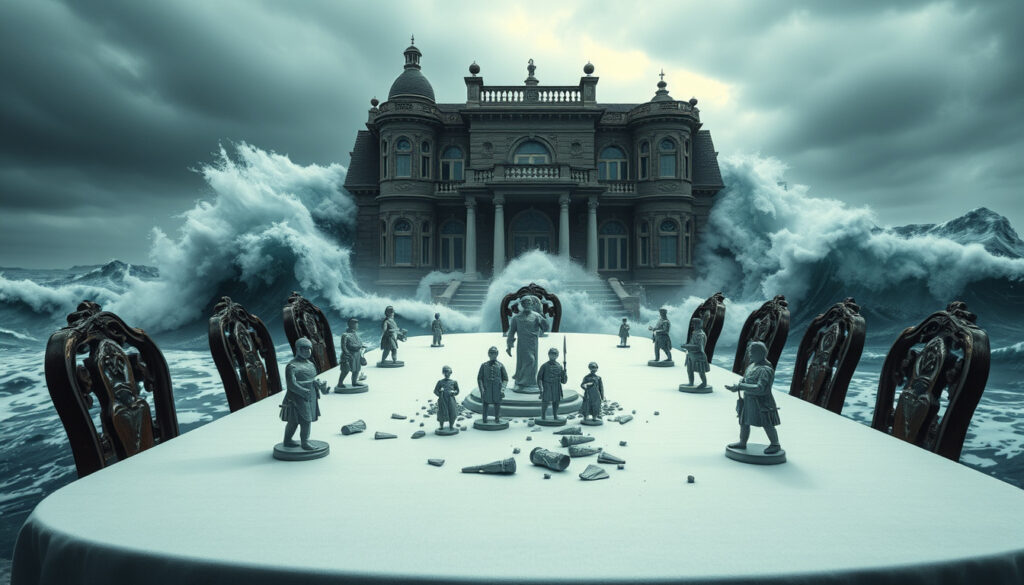
The nursery rhyme serves as both a countdown and a death sentence. Each verse predicts exactly how the next character will die, and each guest is killed in sequence until the final lines: “And then there were none.” The poem’s relentless rhythm creates suspense while also providing the killer with a template. The rhyme appears in every room, in ceramic figurines shaped like the ten soldiers, and in the closing stanzas of every chapter epigraph. The 2015 BBC miniseries uses this poem to structure its three episodes, with each installment corresponding to the dwindling cast.
Who was the actual killer in And Then There Were None?
Justice Wargrave is the orchestrator. He faked his own death early in the narrative—surviving the poisoning attempt that supposedly killed him—and continued to eliminate the remaining guests while they blamed each other. The epilogue, written as his signed confession, explains everything: he suffered from a terminal illness and wanted to experience the ultimate execution before dying. He engineered the invitation list, selected guests with unpunished crimes, and designed the entire scenario as his final case. According to Britannica, the novel explains all the murders but leaves them unresolved in terms of legal justice—the killer is never brought to trial because he is already dead by the time his confession is read.
Justice Wargrave’s Role
Wargrave occupies a unique position in detective fiction: he is simultaneously the judge, the executioner, and the murderer. His entire career involved sending people to death, but he grew disillusioned with a system that allowed wealthy and connected criminals to escape punishment. The invitation to Soldier Island presented him with an opportunity to take the law into his own hands. In the novel’s original ending, he eliminates the final survivors before poisoning himself, ensuring that no one survives to tell the story while also eliminating the evidence of his crimes.
Motive and Method
His motive blends moral righteousness with personal pathology. He saw himself as an instrument of justice for those the law could not reach. His method relied on exploiting each victim’s specific vulnerabilities. He used Vera’s fear of being implicated in a child’s death to manipulate her into the final act. He faked his own death by consuming a sedative, then watched from the shadows as the remaining guests panicked. His confession, written in a cramped hand and sealed in a bottle, was discovered only after the island was cleared. The novel frames this not as a heroic solving of a case but as a systemic failure where vigilantism replaces institutional justice.
Is there a movie based on Agatha Christie’s And Then There Were None?
More than twenty adaptations exist across film, television, stage, and graphic novel formats, making it the most adapted single work in Christie’s catalog. The most celebrated remains the 1945 film directed by René Clair, long considered the best adaptation despite its departures from the source material. The 2015 BBC miniseries, written by Sarah Phelps, holds a distinct distinction: it is the first English-language adaptation to end with every character dead, matching Christie’s original conclusion exactly.
1945 Film
René Clair directed a version that largely follows the novel’s plot but adopts the stage play’s happy ending—a practical choice driven by censorship requirements that prohibited graphic depictions of murder. According to The Boar, most murders happened offscreen, and the final suspects Vera and Lombard were made innocent of their original crimes, allowing them to survive and fall in love. The 1945 film also softened Lombard’s backstory, renaming him Charles Morley to make him more sympathetic. The film was praised in its era for building tension within these constraints, but it fundamentally altered Christie’s vision.
2015 TV Mini-Series
The BBC commissioned the miniseries to commemorate the 125th anniversary of Christie’s birth. Sarah Phelps wrote the adaptation with a mandate to return to the source material, and the result marked a watershed moment for the franchise. According to EuroCultAV, the 2015 version and the 1987 Russian adaptation remain the closest to the novel’s bleak tone. Phelps spent the first episode establishing characters and their backstories, trading pace for psychological depth. The series concludes with a scene where Justice Wargrave speaks directly with Vera before her death—a choice that reinforces the killer’s cold calculation.
Where to Watch
The 1945 film is available on the Criterion Channel, which preserves classic adaptations with supplementary materials. The 2015 BBC miniseries remains exclusive to BBC iPlayer in most regions. A 1965 British version directed by George Pollock relocated the setting to an Austrian mountain resort, while a 1974 adaptation shifted the story to an Iranian desert hotel. The 2017 Japanese miniseries “Soshite daremo inakunatta” offered an Asian interpretation, and HarperCollins published a graphic novel adaptation by François Rivière in 2009.
Is “And then there were none” a banned book?
The novel has appeared on library challenge lists and was featured in past iterations of Banned Book Week due to its original title and certain content elements. The book’s status is complicated: it was not banned by governments but has faced challenges in library systems, primarily around the language in its original title and the graphic depiction of murders. The 1980s retitling to “And Then There Were None” resolved the most common objection, but older editions with earlier titles occasionally surface in collector markets and remain controversial.
Banned Book Week Features
The novel appeared in American Library Association discussions as recently as the 1990s, though it has not been among the most frequently challenged titles in recent years. The shift to the current title eliminated the primary complaint that drove most challenges. However, periodic debates resurface around the violence of the murder sequences and whether the book’s psychological intensity makes it appropriate for younger readers. According to Britannica, changing social mores prompted gradual title adjustments over decades, with “Ten Little Indians” editions continuing into the 1970s.
Reasons for Bans
The two main objections have been the racial slur in the original title and the book’s violent content. The first objection has been addressed through retitling, but the second persists in some library contexts. The murders are depicted in clinical detail, with characters dying in ways that match the nursery rhyme’s predictions. There is no redemption arc, no salvation, and no character who escapes the killer’s plan. For libraries that restrict access to violent content, the book presents a clear challenge.
Can a 12 year old read And Then There Were None?
Common Sense Media rates the book as appropriate for ages 12 and up, though that recommendation reflects a general framework rather than individual readiness. The novel requires emotional maturity to handle the relentless bleakness, the absence of a hero, and the graphic nature of several murder sequences. A 12-year-old who reads thriller fiction may handle it fine; one who struggles with stories where bad things happen to people who do not deserve them may find it distressing. Parents should consider whether their child has the tolerance for a book where everyone dies.
Common Sense Media Review
The organization’s review notes that the book’s strength lies in its puzzle-like structure rather than its character development, and that younger readers often appreciate the logic of the countdown while missing the thematic weight. Parents who read the book alongside their children report productive conversations about justice, guilt, and the difference between Christie adaptations and the original story. The review also notes that the absence of a detective figure distinguishes it from most Christie novels, which may surprise younger readers accustomed to Poirot or Marple arriving to solve cases.
Content Warnings
The book contains depictions of drowning, poisoning, suffocation, and shooting. There is a sequence where a character deliberately causes the death of a child, and another where a character kills out of cowardice. The nursery rhyme provides a spoiler alert of sorts—readers know in advance who will die and roughly how—but the tension comes from watching characters realize their fate is sealed. There is no rescue, no last-minute reprieve, and no moral lesson delivered at the end. The book simply ends with everyone dead.
Why most adaptations change the ending
Christie herself altered the conclusion for the 1943 stage version, introducing a detective character who arrives in time to save the final survivors and expose the killer. She explained that the theatrical format required someone left alive to deliver the explanation, and she believed audiences would not accept a play where every character dies. The producers agreed, and the stage version became the template that most film adaptations followed for decades.
Christie and the producers believed the original ending would not work for theatre because it was too grim and, practically, no one would be left to tell the story.
The 1945 film inherited the stage ending, and the 1959 version directed by Paul Bogart continued the pattern. Subsequent adaptations in 1965, 1970, and 1974 each modified the setting but preserved the survival element, treating the happy ending as a Christie-approved convention rather than a deviation. The pattern held until the 2015 BBC adaptation, which was written with explicit permission to return to the source material.
Most adaptations of And Then There Were None over 80 years have chosen to scrap the original ending in favor of a happy ending.
The implication is straightforward: Christie’s vision was too dark for mainstream audiences throughout most of the twentieth century, and producers consistently softened it to avoid audience discomfort. The 2015 miniseries proved that contemporary viewers could handle the original conclusion, marking a shift in what audiences expect from prestige mystery adaptations.
The 2015 BBC miniseries is the adaptation that respects Christie’s intent most fully. It is also the only major English-language version where the ending matches the novel rather than the stage play. Streaming availability varies by region, but it is worth seeking out if you want to understand why the original story remains controversial.
Christie is famous for writing reassuring mysteries where justice prevails, Poirot solves the case, and order is restored. And Then There Were None refuses all of that. The novel is the outlier in her catalog, and reading it after her other works makes the bleakness even more striking.
A 2015 poll named And Then There Were None the world’s favorite Christie novel, outranking even Murder on the Orient Express. The poll data from Vox Media suggests readers are drawn to the very darkness that made producers nervous for eighty years. The novel’s premise inverts the murder mystery genre: there is no detective, the murderer is never caught, the victims are the killers, and the killers are the victims. According to Britannica, the novel shifts focus from the mystery itself to the victims’ mental and emotional breakdowns, making it less a puzzle and more a psychological study.
Summary
And Then There Were None remains the most provocative work in the Christie catalog because it refuses to play by the genre’s rules. There is no detective, no resolution, no survivor to carry the story forward, and no comfort for readers expecting justice to prevail. The novel has had more adaptations than any other Christie work, but most of those adaptations altered the ending to suit audience expectations. Only in 2015 did an English-language production finally tell the story Christie actually wrote. Readers who want to experience the original vision will find it in the novel itself or in the 2015 BBC adaptation that honored it.
Related reading: Fellowship of the Ring – Complete Guide to Members, Plot and Differences
youtube.com, britannica.com, eurocultav.com, ahsweetmystery.com, apps.voxmedia.com, tvtropes.org, letterboxd.com
Agatha Christie’s And Then There Were None masterfully builds suspense through its isolated murders, as the complete guide and analysis reveals in depth alongside key character insights.
Frequently asked questions
What are the main characters in And Then There Were None?
The ten guests are: Justice Wargrave, Vera Claythorne, Philip Lombard, Emily Brent, General MacArthur, Dr. Armstrong, Sir William Lodwick, Mrs. Rogers, Mr. Blore, and Thomas Rogers. Each is accused of causing a death they escaped punishment for. Justice Wargrave is the killer, revealed in the novel’s epilogue.
When was And Then There Were None published?
The novel was first published in 1939 by Collins Crime Club in the UK, under the title “Ten Little Niggers.” It appeared in the United States under the title “And Then There Were None,” which eventually became the standard title worldwide.
What is the original title of And Then There Were None?
The original UK title was “Ten Little Niggers,” which was later changed to “Ten Little Indians” and then to “Ten Little Soldiers.” The US title was always “And Then There Were None,” and this became the international standard after the 1980s retitling.
Where can I watch And Then There Were None?
The 1945 René Clair film is available on the Criterion Channel. The 2015 BBC miniseries is available on BBC iPlayer in the UK and through streaming services in other regions. Older adaptations from 1965 and 1974 are available through various digital rental platforms.
Is And Then There Were None Agatha Christie’s best book?
A 2015 poll named it the world’s favorite Christie novel, beating Murder on the Orient Express and Death on the Nile. Whether it is the “best” depends on what you value in a mystery, but it is widely considered her most ambitious and controversial standalone work.
What is the most controversial Agatha Christie book?
And Then There Were None is the most controversial due to its original title, its refusal to provide a traditional mystery resolution, and the fact that every character dies. No other Christie novel combines these elements, which is why it continues to spark debate decades after publication.
What is Agatha Christie’s disability?
Agatha Christie dealt with periods of depression throughout her life, particularly during and after her divorce and during World War II. She also suffered from arthritis in later years. She never publicly framed her writing as shaped by disability, and while her personal struggles influenced her work, specific details about how disability shaped And Then There Were None remain unclear.
More related posts
 What Is Open on Good Friday 2026? Ireland & UK Guide
 West End Schnapper Bar Whangārei: Menu, Photos, Delivery
 NZ Tax Brackets 2024: Complete Guide to Rates & Examples
 Compare Car Insurance NZ: Best Sites, Quotes & Providers
 Double Garage Size NZ: Dimensions, Costs & Consent Rules
 Rajadewa138 Login: Complete Situs Slot Guide
 Nike Air Max 90 NZ: Prices, Retailers & Buying Tips
 Breakfast Presenter Jenny-May Clarkson Blooper: What Happened