What Is Renewable Energy – Definition, Types, Benefits
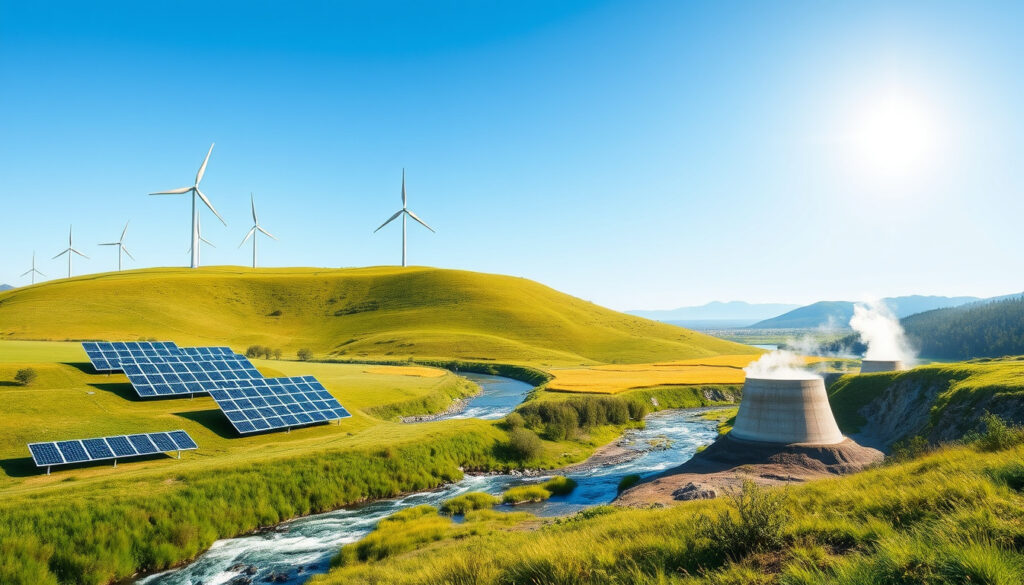
Renewable energy has emerged as a cornerstone of modern power generation, representing a fundamental shift from finite fossil fuels toward sources that nature continuously replenishes. From sunlight to wind, from flowing water to heat beneath the Earth’s surface, these energy sources offer a sustainable pathway forward as nations worldwide pursue cleaner alternatives.
The transition toward renewable energy reflects both environmental necessity and technological opportunity. An overdue energy revolution is underway, with renewables increasingly displacing fossil fuels particularly in the power sector. This transformation carries profound implications for climate goals, economic development, and energy security across the globe.
What Is Renewable Energy?
Renewable energy is usable energy generated from naturally recurring processes that are self-replenishing and have a low or zero-carbon footprint. These sources derive from unlimited natural resources continuously replenished through planetary processes, making them fundamentally different from finite fossil fuels formed over millions of years.
Energy from sources that won’t run out due to continuous natural replenishment
Solar, wind, hydro, geothermal, biomass, and tidal power
Low emissions, inexhaustible supply, reduced dependence on fossil fuels
Over half of Italy’s electricity came from renewables in 2024
Renewable resources are naturally replenishing but flow-limited; they are virtually inexhaustible though limited by resource availability at any given location. The terms “renewable energy,” “green energy,” and “clean energy” are often used interchangeably, though subtle distinctions exist. Green energy broadly refers to energy derived from natural resources, while clean energy emphasizes low or zero emissions.
Renewable vs. Non-Renewable Energy
The distinction between renewable and non-renewable energy sources represents one of the most consequential dividing lines in modern energy policy. Fossil fuels including coal, petroleum, and natural gas have dominated energy production since the late 1800s, yet they exist in finite quantities formed over geological timescales.
- Renewable sources are continuously replenished through natural processes occurring on human timescales
- Non-renewable fossil fuels take millions of years to form and exist in limited quantities
- Burning fossil fuels releases carbon stored over millennia, contributing to atmospheric accumulation
- Renewable sources have a low or zero-carbon footprint compared to conventional fossil fuels
- Once extracted, non-renewable fuels are gone forever; renewable sources persist indefinitely
- Technology costs for renewables have declined dramatically while fossil fuel prices remain volatile
Until the mid-1800s, wood provided nearly all the nation’s energy for heating, cooking, and lighting. Hydropower and wood remained the dominant renewable sources until the 1990s, when solar, wind, and geothermal began significant expansion.
| Fact | Detail | Source |
|---|---|---|
| Global solar potential | Could supply one-third of global energy by 2060 with sufficient government commitment | Prysmian Group |
| Solar employment | 4.9 million solar jobs worldwide in 2022, over one-third of all renewable energy positions | Southern New Hampshire University |
| Italy’s renewable share | 51.8% of total national electricity production in 2024 | Enel Group |
| US hydropower share | 28.7% of total U.S. renewable electricity generation | Southern New Hampshire University |
| Iceland heating | Over 90 percent of heating demand met through geothermal energy | Prysmian Group |
| Earth’s core temperature | Approximately 5,500°C, providing virtually unlimited geothermal potential | Chandra Asri |
What Are the Main Types of Renewable Energy?
Six primary renewable and clean energy sources currently power the global transition away from fossil fuels: solar, wind, geothermal, hydro, tidal, and biomass. Each harnesses different natural processes and offers distinct advantages depending on geographic location, climate conditions, and energy requirements.
Solar Energy
Solar energy ranks among the most versatile renewable sources available today. Photovoltaic cells transform sunlight directly into electricity through the photovoltaic effect, whether deployed on residential rooftops or in vast utility-scale installations. Concentrating solar power systems use mirrors to focus solar radiation, generating heat that drives turbines for electricity production.
Solar has demonstrated remarkable growth trajectories. According to the International Energy Agency, solar technologies could constitute up to one-third of global energy sources by 2060 given adequate policy support. The sector has also become the fastest-growing source of renewable energy employment, with nearly 4.9 million solar jobs documented worldwide in 2022.
Wind Energy
Wind power stands as the largest producer of renewable electricity in both the United Kingdom and the United States. Wind uniquely qualifies as renewable, green, and clean energy simultaneously, meeting all three sustainability categories.
Onshore and offshore wind farms generate electricity through a straightforward mechanism. Turbine blades capture kinetic energy from moving air and spin a drive shaft connected through a gearbox to a generator, converting mechanical motion into electrical energy. Coastal offshore installations often experience stronger and more consistent wind patterns than land-based facilities.
Hydropower
Hydropower relies on the natural flow of water to generate electricity, making it one of the oldest and most established renewable technologies. Hydroelectric plants at dams direct flowing or falling water through underwater turbines, spinning generators to produce power on demand.
This technology accounts for 28.7% of total U.S. renewable electricity generation and historically served as Italy’s primary renewable source. However, photovoltaics surpassed hydroelectric power in Italy during June 2025, reaching 42.6% compared to hydroelectric’s 37.5%. Wave and tidal power represent emerging hydropower applications that harness ocean forces at the mouths of large bodies of water.
Geothermal and Biomass
Geothermal energy taps heat originating from beneath the Earth’s surface, with the planet’s core maintaining temperatures around 5,500°C. Geothermal plants draw steam from underground reservoirs to power turbines, and when water and steam are reinjected into the reservoir, emissions remain minimal.
Unlike solar and wind power, geothermal energy generation remains consistent regardless of weather conditions or time of day, providing reliable baseload power in suitable geographic regions.
Biomass and bioenergy systems burn organic matter including plants, timber, agricultural residues, and food waste to generate electricity. While carbon dioxide releases during combustion, biomass qualifies as renewable because these materials can be regrown and absorb equivalent amounts of carbon across their growth cycles.
What Are the Benefits of Renewable Energy?
Renewable energy offers compelling advantages across environmental, economic, and strategic dimensions. These benefits drive accelerating adoption rates and sustained policy support across developed and developing nations alike. For a deeper dive into the topic, you can read about the Green hydrogen systems konkurs. Green hydrogen systems konkurs
Environmental Advantages
The most immediate benefit of renewable sources lies in their minimal environmental footprint. Unlike fossil fuel combustion, renewable generation produces little to no direct carbon emissions during operation. This characteristic makes renewables essential for achieving national and international climate commitments under agreements like the Paris Accord.
Air quality improvements accompany the transition away from coal and oil combustion, reducing respiratory illnesses and environmental damage associated with acid rain and smog formation.
Economic Benefits
The renewable energy sector has become a significant engine of economic growth and employment. Solar energy alone represents the fastest-growing segment of renewable jobs globally. Manufacturing, installation, maintenance, and supporting services have created millions of skilled positions that cannot be offshored.
Technology cost curves have shifted decisively in renewables’ favor. Solar photovoltaic module prices have fallen over 90% since 2010, while wind turbine costs continue declining. These price reductions translate to lower electricity costs for consumers and improved competitiveness for businesses.
Energy Security
Domestic renewable resources reduce dependence on imported fuels subject to geopolitical instability and price volatility. Nations with abundant renewable potential can develop indigenous energy supplies, strengthening economic resilience and reducing trade imbalances associated with fossil fuel imports.
How Does Renewable Energy Work?
Each renewable technology employs distinct mechanisms to capture natural energy flows and convert them into usable electricity. Understanding these conversion processes clarifies why different sources suit different applications and geographic contexts.
Solar technologies rely on photovoltaic cells that generate electric current through semiconductor materials when exposed to sunlight. Alternatively, concentrating solar thermal systems use mirrors to focus sunlight, heating fluids that drive steam turbines. Wind turbines employ aerodynamic blade design to capture kinetic energy from air movement, transferring rotational force through drivetrains to generators. Hydroelectric facilities channel water flow through turbines, with pumped-storage installations providing grid-scale energy storage capabilities. Geothermal plants access underground steam reservoirs or use heat exchanger systems to extract thermal energy from hot rock formations. Biomass combustion generates heat for conventional steam turbine generators, with advanced facilities using gasification or anaerobic digestion for improved efficiency.
Solar and wind generation varies with weather conditions and time of day, requiring grid management strategies including energy storage, demand response, and complementary generation sources to ensure reliable supply.
The Evolution of Energy Sources
Humanity’s relationship with energy has undergone profound transformations across centuries, with each transition responding to technological capabilities and resource availability.
- Pre-industrial era: Wood, animal power, and human labor dominated energy consumption for heating, cooking, and transportation
- Mid-1800s transition: Coal began displacing wood as industrialization accelerated, eventually becoming the dominant 19th-century fuel
- Petroleum emergence: The late 1800s and early 1900s saw petroleum and natural gas expand rapidly for transportation and heating
- Mid-20th century: Fossil fuels achieved near-universal dominance across electricity generation, industry, and transportation
- 1970s oil crisis: Price shocks and supply disruptions catalyzed interest in energy diversification and efficiency
- Late 20th century growth: Wind and solar began meaningful commercial deployment alongside continued hydropower expansion
- 2020s acceleration: Renewables now compete directly with fossil fuels on cost while delivering superior environmental performance
What Is Established Versus Uncertain?
| Well-Established Facts | Areas of Uncertainty |
|---|---|
| Renewable sources produce minimal direct emissions compared to fossil fuels | Exact timeline for achieving specific decarbonization targets varies by scenario assumptions |
| Solar and wind have become cost-competitive with fossil generation in many markets | Long-term grid integration costs depend on storage technology development trajectories |
| Hydropower provides reliable baseload generation and grid stability services | Regional resource potential estimates require ongoing refinement as exploration continues |
| Geothermal offers weather-independent baseload power in suitable locations | Advanced nuclear fusion remains under development with commercial timelines uncertain |
| Biomass can be considered carbon-neutral under proper land management | Full lifecycle emissions accounting for some renewable technologies remains complex |
Understanding Renewable Energy in Context
Renewable energy represents more than a technological category—it embodies a fundamental reimagining of humanity’s relationship with natural systems. The transition involves complex interactions between policy frameworks, market structures, infrastructure requirements, and social acceptance factors.
Grid infrastructure developed over the past century was designed around centralized fossil fuel power plants with controllable output. Integrating variable renewable sources requires modernizing electricity networks through enhanced transmission capacity, smart grid technologies, and energy storage deployment. These investments create economic opportunities while addressing technical challenges.
Policy mechanisms including renewable portfolio standards, tax incentives, carbon pricing, and clean energy mandates have accelerated deployment across numerous jurisdictions. International cooperation through bodies like the International Renewable Energy Agency facilitates knowledge sharing and capacity building among nations at different stages of energy transition.
Expert Perspectives on Renewable Energy
“An overdue energy revolution is underway, with renewables increasingly ousting fossil fuels, particularly in the power sector.”
“Hydropower and wood were the most used renewable energy resources until the 1990s; since then, U.S. energy consumption from biofuels, geothermal energy, solar energy, and wind energy have increased.”
Industry analysts and government agencies consistently highlight renewable energy as central to sustainable development strategies. The U.S. Department of Energy maintains that accelerating renewable deployment represents an essential pathway toward meeting emissions reduction commitments while ensuring reliable, affordable electricity supply.
Summary
Renewable energy encompasses naturally replenishing sources including solar, wind, hydro, geothermal, biomass, and tidal power that generate electricity with minimal carbon emissions. These technologies have evolved from niche applications to mainstream power sources capable of competing economically with conventional fossil fuels. Global capacity continues expanding rapidly as nations pursue climate goals and energy security objectives, fundamentally reshaping electricity systems worldwide.
Understanding renewable energy fundamentals positions readers to evaluate ongoing developments in this critical sector transforming global infrastructure. For those seeking analytical perspectives on data-driven approaches across different domains, the Houston Rockets vs Golden State Warriors Stats resource offers complementary insights into statistical analysis methodologies.
Frequently Asked Questions
What are the main disadvantages of renewable energy?
Primary challenges include intermittency for solar and wind, geographic limitations for resources like geothermal, higher upfront capital costs despite lower operating expenses, and land use requirements for large-scale installations. Energy storage costs and grid integration infrastructure also present technical hurdles.
Is renewable energy expensive compared to fossil fuels?
Solar and wind generation have achieved cost parity or superiority with fossil fuels in many markets. However, total system costs including storage and grid upgrades vary by location, resource quality, and existing infrastructure. Lifecycle cost comparisons increasingly favor renewables.
How can homeowners use renewable energy?
Residential solar panel installation represents the most accessible option, often combined with battery storage systems. Community solar programs allow participation without rooftop installations. Purchasing renewable energy through utility green power programs provides another avenue for household participation.
Which countries lead in renewable energy adoption?
Nordic countries including Iceland, Norway, and Sweden demonstrate high renewable shares, primarily through hydropower and geothermal resources. Germany, Spain, and Denmark have achieved substantial wind and solar penetration. China leads total installed renewable capacity globally.
How does renewable energy affect electricity bills?
Initial periods following renewable installation may increase monthly costs due to financing, though long-term savings typically materialize as utility rates rise. Net metering arrangements can provide bill credits for excess generation. Community programs offer renewable benefits without upfront investment.
More related posts
 Why Is My Vagina Itchy? Causes & Relief Guide
 How to Grill Vegetables: Tips for Perfect Char & Healthy Results
 Super Rugby Points Table 2025: Standings, Scoring & Playoffs
 Doom: The Dark Ages: Hit or Flop? Worth Buying in 2025
 Boundary Fence Rules NZ: Height, Costs & Disputes Guide
 What Do Eels Eat? Wild, Freshwater, and Pet Diet Guide
 Rental Cars Wellington Airport: Best, Cheapest & Compare
 New Year Festival Weather 2026: Ireland Forecast & Climate Trends