Area of a Triangle: Formula, Examples, and Calculator Guide
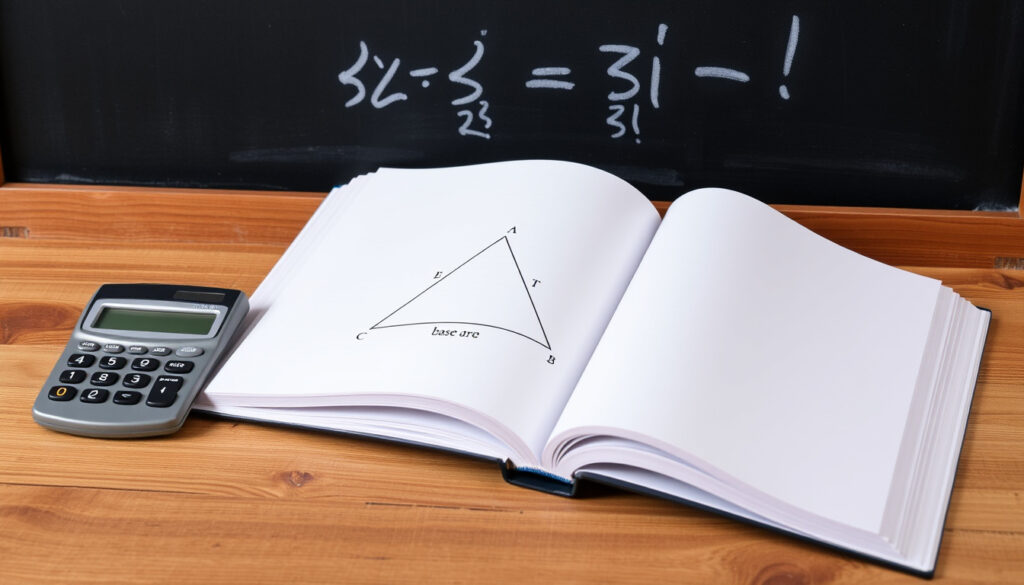
Maybe you last thought about triangle area in school, staring at a chalkboard diagram of base and height. The formula that stuck—half of base times height—is the fastest route when you know those two measurements, and it’s the method taught in textbooks as the primary approach, according to Third Space Learning (US math tutorial resource). But what if you only have the three side lengths, or two sides and the angle between them? This guide walks through every major method, with step-by-step examples and source-backed explanations, so you can find the area no matter what numbers you start with.
Basic area formula: ½ × base × height · Area with 3 sides (Heron’s): √[s(s-a)(s-b)(s-c)] · Triangle types area variations: right, equilateral, isosceles, scalene · Area with sine rule: ½ ab sin(C)
Quick snapshot
- Area = ½ × base × height works for any triangle (Math is Fun (geometry teaching site))
- Heron’s formula works for any triangle with three known sides (Math Open Reference (math reference site))
- No ambiguity in the established formulas — all three methods are mathematically proven (Omni Calculator (interactive math tool))
- Heron’s formula is named after Hero of Alexandria (c. 60 AD) (Wikipedia (community-edited encyclopedia))
- Practice with real examples and check results using an interactive triangle area calculator (Omni Calculator)
Five key formulas, one theme: area always comes down to base, sides, or angles. Here’s how they compare.
| Label | Formula | When to use |
|---|---|---|
| Core formula | ½ × base × height | Base and perpendicular height known |
| Heron’s formula | √[s(s-a)(s-b)(s-c)] | All three sides known |
| Sine method | ½ ab sin(C) | Two sides and included angle known |
| Right triangle shortcut | ½ × legs (base × height) | Right triangle with legs known |
| Equilateral triangle area | (√3/4) × side² | All sides equal |
The implication: the right formula depends entirely on which measurements you already have. No single method is “best” — only most appropriate.
What is the formula for area of a triangle?
The standard formula is Area = ½ × base × height. Here, “height” means the perpendicular distance from the base to the opposite vertex. BYJU’S (Indian ed-tech platform) states that this formula works for any triangle, not just right triangles, as long as you measure the perpendicular height. The area is always expressed in square units.
Why it works (area of parallelogram half)
- Any triangle is exactly half of a rectangle or parallelogram with the same base and height (Third Space Learning (US math tutorial resource))
- Doubling the triangle gives a parallelogram whose area is base × height, so the triangle is half that
If your triangle has a known base and a perpendicular height, this method is the simplest and most widely taught. For a right triangle, the legs serve as base and height directly (MathBitsNotebook (geometry reference)).
For example: a triangle with base 8 cm and height 5 cm has area = ½ × 8 × 5 = 20 cm². Math is Fun (geometry teaching site) walks through this exact calculation step by step.
The pattern: base-height works every time you have both measurements. But when height isn’t given, you need a different approach.
How to find area of a triangle with 3 sides but no height?
When you know all three side lengths but not the height, Heron’s formula is the solution. Named after the ancient Greek mathematician Hero of Alexandria, it calculates area using only the three sides. The Math Doctors (math Q&A archive) explain that the formula is Area = √[s(s-a)(s-b)(s-c)], where s = (a+b+c)/2 is the semiperimeter.
Heron’s formula step by step
- Add the three side lengths and divide by 2 to get s
- Subtract each side length from s: (s-a), (s-b), (s-c)
- Multiply s × (s-a) × (s-b) × (s-c)
- Take the square root of that product
Math Open Reference (math reference site) provides a worked example: a triangle with sides 7, 8, 9 units has s = 12, then area = √[12×5×4×3] = √720 ≈ 26.83 square units.
Heron’s formula can produce very small or large results if the sides don’t actually form a triangle (e.g., one side longer than the sum of the other two). Always verify the triangle inequality first (Omni Calculator (interactive math tool)).
What this means: Heron’s formula is your go-to when height is absent. It works for scalene, isosceles, equilateral, and even obtuse triangles.
What’s the simplest way to find a triangle’s area?
If you already have the base and height, the base-height method is the simplest — just multiply and halve. If you have two sides and the included angle, the sine rule method (Area = ½ ab sin(C)) is equally straightforward. MathBitsNotebook (geometry reference) emphasizes that this formula is particularly useful for non-right triangles where the height is not easily measured.
When to use each method
- Base and height known: Area = ½ × base × height
- Two sides and included angle known: Area = ½ ab sin(C)
- Only three sides known: Heron’s formula
Omni Calculator (interactive math tool) offers a single tool that accepts whichever inputs you have and returns the area, confirming the flexibility of these methods.
Think of the sine formula as the base-height formula extended: when the height isn’t perpendicular, sin(C) adjusts the angle. A video from Math with Mr. J (YouTube tutorial) uses simple mnemonics to help students recall: “half times base times height, unless you’ve got two sides and an angle in sight.”
The trade-off: base-height is fastest but requires the height; Heron’s is universal but involves a square root; the sine method balances convenience and accuracy when you have an angle.
Step-by-step examples for each method
Practice builds confidence. Below are three worked examples using real numbers from Think Academy (tutoring resource) and other sources.
Example 1: Base and height (right triangle)
- Given: base = 6 cm, height = 4 cm
- Area = ½ × 6 × 4 = 12 cm²
- Check with Omni Calculator (interactive math tool)
Example 2: Heron’s formula (three sides)
- Given: sides a=5, b=6, c=7
- s = (5+6+7)/2 = 9
- Area = √[9×4×3×2] = √216 ≈ 14.70 square units
- Source: The Math Doctors (math Q&A archive)
Example 3: Sine method (two sides and included angle)
- Given: sides a=8, b=10, angle C=30°
- Area = ½ × 8 × 10 × sin(30°) = 40 × 0.5 = 20 square units
- Verified by MathBitsNotebook (geometry reference)
For learners who want more practice, a YouTube lesson on triangle area for children also walks through base-times-height with visual exercises.
What’s confirmed about triangle area formulas
- Area = ½ × base × height is universally accepted for any triangle (Math is Fun (geometry teaching site))
- Heron’s formula is valid for any triangle with three known side lengths (Math Open Reference (math reference site))
- The sine method Area = ½ ab sin(C) works for any triangle where two sides and the included angle are known (MathBitsNotebook (geometry reference))
- All three formulas produce the same result when applied to the same triangle with consistent inputs (Omni Calculator (interactive math tool))
The implication: any method you choose is mathematically sound. The only variable is which measurements you start with.
Expert perspectives on triangle area
“The area of a triangle is 1/2 × base × perpendicular height.”
“Doubling the triangle gives a parallelogram with base b and height h; the area of that parallelogram is bh, so the triangle is ½ bh.”
“The calculator supports base-height, three-side, and side-angle-side methods — whichever you prefer.”
Omni Calculator (interactive math tool)
Each source reinforces the same core truth: triangle area is about matching the formula to the known data, not memorizing one rigid method.
For anyone learning geometry, the choice between methods is clear: start with base and height if you have them, then explore Heron’s or the sine rule for tricky cases. The consequence of ignoring this flexibility is wasted time or incorrect results. For students and DIY calculators alike, knowing all three methods means never being stuck — just pick the one that fits your numbers. For further practice, see our related guide on Times Tables .com: #1 Multiplication Practice Site Guide and Where to Find Free Tutorials: Best Sites, Platforms & Apps.
Frequently asked questions
Does Heron’s formula work for all triangles?
Yes, Heron’s formula works for any triangle — right, acute, obtuse, scalene, isosceles, equilateral — as long as all three side lengths are known (Math Open Reference (math reference site)).
Can I use base × height for a right triangle?
Absolutely. In a right triangle, the legs are perpendicular, so one leg can be base and the other height. Formula: Area = ½ × leg1 × leg2 (Math is Fun (geometry teaching site)).
What if I only know two sides and the angle?
Use the sine rule: Area = ½ × side1 × side2 × sin(included angle). This works for any triangle (MathBitsNotebook (geometry reference)).
How do I find the height of a triangle?
If you know the area and base, rearrange the formula: height = (2 × area) / base. For triangles where height isn’t given, use Heron’s or the sine method instead (Third Space Learning (US math tutorial resource)).
Is triangle area always half of base times height?
Yes, the formula ½ × base × height is universal for any triangle, provided you use the perpendicular height. It works for acute, obtuse, and right triangles (BYJU’S (Indian ed-tech platform)).
What is the area of an isosceles triangle?
For an isosceles triangle, use base and height if known, or if only sides are known, use Heron’s formula. The method does not change just because two sides are equal (Omni Calculator (interactive math tool)).
Why does the sine formula give area?
Because ½ ab sin(C) calculates the area of a parallelogram with sides a and b, then halves it — just like base × height, but using sin(C) to find the vertical component of side b relative to a (The Math Doctors (math Q&A archive)).
More related posts
 Credit Card Application Form – Step-by-Step Guide
 How to Train Your Dragon 4: Is It Coming Out
 Products Offered by Bunnings Warehouse Christchurch Airport
 What Is Open on Good Friday 2026? Ireland & UK Guide
 12 Days of Christmas: Song Meaning, Gifts, and Dates Explained
 Download from YouTube SaveFrom.net – Step-by-Step Guide
 Maggie Baugh Keith Urban: Dating Rumors and Tour Split
 78 Fahrenheit to Celsius: Warm or Cool