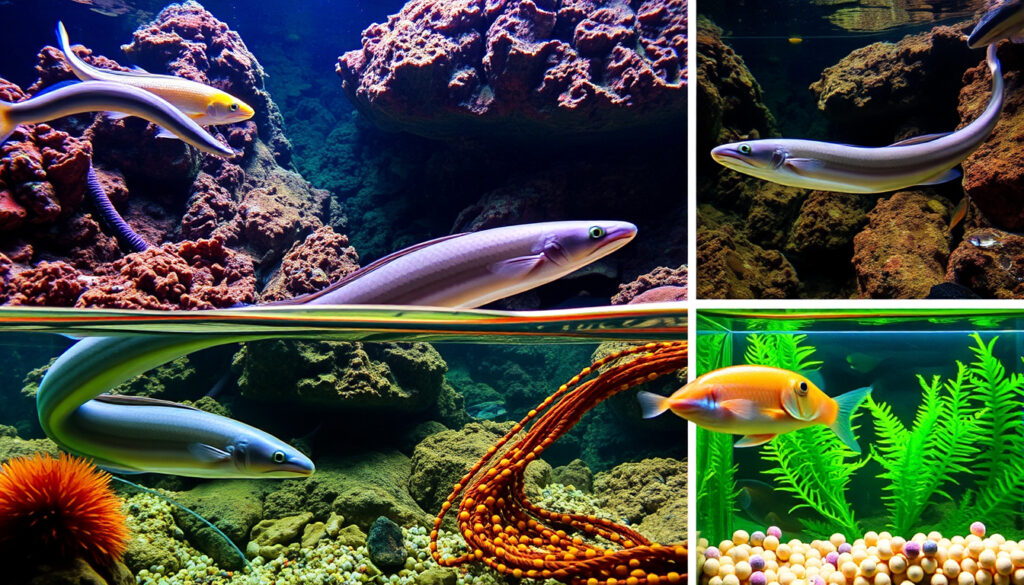
What Do Eels Eat? Wild, Freshwater, and Pet Diet Guide
If you’ve ever watched an eel glide through water with that sinuous, snake-like motion, you might have wondered what actually keeps those sleek predators going. The short answer: they are confirmed carnivores that hunt prey across depths from 0 to 700 meters, according to research published in scientific literature. But the full picture — what specifically fills an eel’s stomach in the wild versus in captivity, and how that changes as they grow — is more layered than a simple predator list.
Primary Diet: Insects, fish, crustaceans · Freshwater Eel Food: Invertebrates, small fish, worms · Life Stage Shift: Small eels: insects; Adults: fish, birds
Quick snapshot
- Diet includes insects, fish, crustaceans across sources
- Sharp, backward-facing teeth confirmed by veterinary hospitals
- Bite is painful but not poisonous — no recorded human fatalities
- European eels critically endangered due to dams, overfishing, parasites
- Exact spawning diet mysteries from WWF
- Long-term survival rates for European eels in captivity
- EU regulations on keeping European eels as pets due to endangered status
- Comparative feeding costs and availability in Europe
- Petco freshwater eel caresheet published 2016
- European eel larvae first-feeding study documented at 10 days post-hatch
- Japanese eel larvae survival to 100 dph achieved through research
- Improved larval diet protocols may boost European eel conservation
- Pet owners warned against hand-feeding due to bite risks
- Critical endangerment status limits wild collection
The table below summarizes key eel dietary attributes drawn from verified wildlife sources.
| Attribute | Value |
|---|---|
| Diet Type | Carnivorous |
| Key Prey | Fish, crustaceans, insects |
| Habitat | Freshwater rivers, ocean migration |
| Teeth | Sharp, backward-facing |
| Bite Toxicity | Not poisonous |
What do UK eels eat?
The European eel (Anguilla anguilla) native to UK waters follows a nocturnal hunting pattern, using its keen sense of smell to locate prey in darkness. Research from the scientific literature shows they feed at depths ranging from 0 to 700 meters, taking whatever prey fits their size.
European eel diet
- Worms and earthworms
- Small fish species
- Mollusks including slugs
- Crustaceans such as crayfish
- Plankton during larval stages
According to scientific analysis, European eels in the wild feed mainly at night on worms, fish, mollusks like slugs, crustaceans like crayfish, and plankton. The implication: their adaptability to varied prey types helps explain their wide distribution across European freshwater systems.
Freshwater feeding habits
In UK rivers and estuaries, eels transition from hunting tiny invertebrates as juveniles to taking larger prey as adults. Research from Fisheries Ireland confirms that eels feed on invertebrates and small fish throughout their freshwater residency. What this means: even in a single river system, an eel’s diet shifts substantially depending on its size and age.
“Feed on invertebrates and small fish.”
— Fisheries Ireland (Government Fisheries Body)
The European eel is critically endangered due to dams, overfishing, and parasites. UK populations face additional pressure from habitat loss, making any diet research tied to conservation efforts especially valuable.
What do eels eat in freshwater?
Freshwater eels across multiple species share broadly similar dietary preferences, though exact prey varies by region and eel size. PBS Nature documents that freshwater eels consume smaller fish, invertebrates, and shrimp, while the New Zealand Department of Conservation notes insect larvae, worms, and water snails as staples for juvenile eels.
Small eels diet
Baby eels — called elvers — start with the smallest prey available in their habitat. Research from the scientific literature shows European eel larvae first-feeding was tested from 10 days post-hatch with experimental diets, with best survival documented up to 28 days post-hatch on optimal diets.
- Insect larvae (mosquito larvae particularly common)
- Small worms and aquatic invertebrates
- Water snails
- Tiny crustaceans
- Plankton in early stages
Improved eel larvae diet research led to survival up to 100 days post-hatch for Japanese eel — a breakthrough with direct relevance for European eel conservation efforts in UK waters.
Adult freshwater eels
As eels grow, their prey choices expand dramatically. Adult freshwater eels can take on vertebrates and, in some cases, birds. The New Zealand Department of Conservation notes that larger eels may eat prey items that seem surprising for a fish — including birds encountered at the water’s edge.
- Larger fish (minnows, guppies, smelt)
- Crayfish and crabs
- Shrimp and other crustaceans
- Worms and mollusks
- Occasional birds for very large adults
According to aquarium feeding protocols from the South Carolina Aquarium, freshwater American eels — closely related to European species — are fed smelt and earthworms once or twice weekly in captivity. What this means: adult eels thrive on protein-rich whole prey, whether fresh or frozen, and can maintain health on relatively infrequent feeding schedules.
“For our freshwater American eel, they receive a mix of smelt along with earthworms!”
— South Carolina Aquarium (Public Aquarium Institution)
What do you feed a pet eel?
Keeping eels as pets requires a serious commitment to their specific dietary and environmental needs. According to detailed care guides from Pet Supplies Plus, freshwater eels need sinking shrimp pellets, appropriately sized tropical fish pellets, or frozen or freeze-dried insect larvae — offered daily in most cases.
Suitable foods
The range of appropriate foods for pet eels is surprisingly broad, but preparation matters. Petco’s official freshwater eel caresheet from 2016 specifies that a well-balanced freshwater eel diet includes frozen, live, pelleted, or freeze-dried food, fed once a day in the evening. Chicago Exotics Animal Hospital adds that dietary protein for freshwater eels should range between 35% and 45%.
- Sinking shrimp pellets
- Tropical fish pellets (appropriately sized)
- Frozen or freeze-dried insect larvae
- Brine shrimp
- Bloodworms
- Earthworms and smelt
- Meaty chunks: shrimp, squid, clams, capelin
Pet eels can be successfully weaned from live to prepared foods like pellets — a shift that benefits their long-term health and simplifies care routines. Bulk Reef Supply notes this transition reduces disease risks while maintaining proper nutrition.
Feeding tips
Veterinary guidance from Chicago Exotics Animal Hospital recommends feeding pet eels 1 to 2 times per week, offering only what they consume readily to avoid water quality issues. The implication: overfeeding is a more common mistake than underfeeding with captive eels — excess food deteriorates water conditions rapidly.
- Offer sinking pellets or frozen foods once daily in evening
- Remove uneaten food within 1-2 minutes
- Some freshwater eels may refuse food for 2-3 weeks (normal behavior)
- Vitamin C supplements may help disease prevention if diet is varied
- Do not hand-feed due to poor eyesight and excellent smell — bite risk is real
Chicago Exotics Animal Hospital specifically warns against hand-feeding eels: due to their poor eyesight and excellent sense of smell, they may bite unexpectedly, and those bites can become painfully infected. What this means: use feeding tongs or simply drop food into the tank, never your fingers.
“Although the exact dietary protein requirements for eels has not been established, a general range of 35 – 45% is recommended for most freshwater species.” For more information on eel diets, you can explore the What’s Eating Gilbert Grape cast.
— Chicago Exotics Animal Hospital (Exotic Pet Veterinary Practice)
Do eels eat other eels?
Eel cannibalism is documented but situational — it depends on relative size, available prey, and species. The pattern: larger eels will prey on smaller conspecifics if hungry enough, while well-fed eels typically ignore tank-mates of similar size.
Cannibalism evidence
Chicago Exotics Animal Hospital notes that pet eels rarely attack tank-mates if well-fed, but some eat crabs and shrimp — indicating a general willingness to consume smaller animals that fit in their mouths. The trade-off: if keeping multiple eels together, significant size differences create predation risk.
- Larger eels will prey on smaller eels
- Cannibalism more likely in crowded conditions
- Well-fed eels less likely to attack tank-mates
- Juvenile eels (elvers) may be eaten by adults
Do eels eat humans?
Despite their fearsome appearance and sharp teeth, documented human attacks by eels are extremely rare. The New Zealand Department of Conservation notes eels may bite defensively if provoked or cornered, but unprovoked attacks on humans have not been recorded in scientific literature. What this means: eels should be respected for their teeth, not feared as human predators.
Eels hunt via scent at night, biting chunks from larger fish — yet humans walking in shallow water rarely trigger any predatory response. The likely explanation: eels have learned that humans are not typical prey items in their environment.
Do eels have teeth and are eel bites dangerous?
Yes — eels have teeth, and they are not decorative. The arrangement and sharpness varies by species, but all true eels possess well-developed dentition designed for gripping and tearing prey.
Eel teeth
Eel teeth are sharp and backward-facing, an arrangement designed to prevent prey from escaping once bitten. According to veterinary hospital analysis, eels hunt by scent at night, biting chunks from larger fish rather than swallowing prey whole. The pattern: their teeth function like a one-way trap, making escape nearly impossible for captured prey.
- Sharp, backward-facing teeth
- Multiple rows in some species
- Teeth designed for gripping, not chewing
- Replaced periodically throughout life
Bite risks
Eel bites are painful and carry infection risk, but they are not poisonous. Chicago Exotics Animal Hospital confirms that eel bites can become infected due to bacteria in the eel’s mouth, not due to venom. The catch: because eels have poor eyesight, they sometimes bite humans accidentally, mistaking fingers for food — especially during hand-feeding attempts.
Health sources confirm that eel bites are painful but not poisonous, with the primary concerns being bacterial infection and potential tissue damage from the bite force itself. Medical guidance recommends cleaning any eel bite thoroughly and seeking care if infection signs develop.
European eels as pets require cold water, heavily impact water quality, are aggressive, and die quickly according to aquarist community reports. The combination of specialized needs, endangered status, and potential bite risk means European eels are not recommended for casual pet owners.
Upsides
- Captive eels can be fed prepared foods (pellets, frozen)
- Freshwater eels thrive on 1-2 feedings per week
- Diet can be varied with shrimp, worms, fish chunks
- No venom risk from bites
Downsides
- Bites can become infected
- European eels critically endangered
- Aggressive behavior in captivity
- High water quality demands
Related reading: healthy eating guide · grocery list
petsuppliesplus.com, a-z-animals.com, s7d1.scene7.com, en.wikipedia.org, scaquarium.org, youtube.com, exoticpetvet.com, youtube.com, pmc.ncbi.nlm.nih.gov, bulkreefsupply.com
Frequently asked questions
Where do eels live?
Eels live across freshwater rivers and oceans, with many species migrating between the two during their life cycle. The European eel ranges from 0 to 700 meters depth during feeding phases, while American eels follow similar patterns across Atlantic waters.
Is an eel a fish or a snake?
An eel is a fish — specifically a long, slender member of the Anguilliformes order. Despite their snake-like appearance, they have gills, scales, and fins, classifying them definitively as fish.
What is a crazy fact about eels?
European eels are critically endangered yet have one of the most remarkable migrations in the animal kingdom — they spawn in the Sargasso Sea and their larvae drift across the Atlantic for years before transforming into glass eels and entering European rivers.
Why can’t eel be eaten raw?
Raw eel can contain parasites and bacteria that are eliminated through cooking. Japanese cuisine does feature cooked eel (unagi), but it is always grilled and sauced rather than served raw like sushi-grade fish.
What do eels do?
Eels primarily hunt and eat, spending nights actively pursuing prey using their sense of smell. They also migrate vast distances to spawn, with European eels traveling thousands of kilometers to the Sargasso Sea for reproduction.
Do eels have teeth?
Yes, eels have sharp, backward-facing teeth designed to grip prey. Their bite is painful but not poisonous, though infection risk from bacteria exists.
For anyone considering keeping European eels as pets, the stakes are clear: these are critically endangered animals with demanding care requirements, aggressive tendencies, and bite risks that make them poor choices for most aquarists. Conservation programs and dedicated specialists who understand eel diet gain the most from this knowledge — better alternatives exist for freshwater tanks, but for researchers and conservationists, understanding eel diet remains foundational to both captive breeding programs and wild habitat protection efforts.
More related posts
 Air New Zealand Pet Travel 2025: Rules, Costs & Booking
 Samsung S24 Ultra NZ: Price, Specs, and Where to Buy
 Times Tables .com: #1 Multiplication Practice Site Guide
 Ms Rachel Toys in New Zealand: Where to Buy, Prices & More
 Fenerbahçe vs Nottm Forest: Results, Stats & Live Updates
 Funny Jokes for Adults – Hilarious One-Liners and Puns
 Athletic Club vs Man United – Europa League Semi-Final Preview
 Aria on Bank Dunedin: 4.5-Star Motel Guide