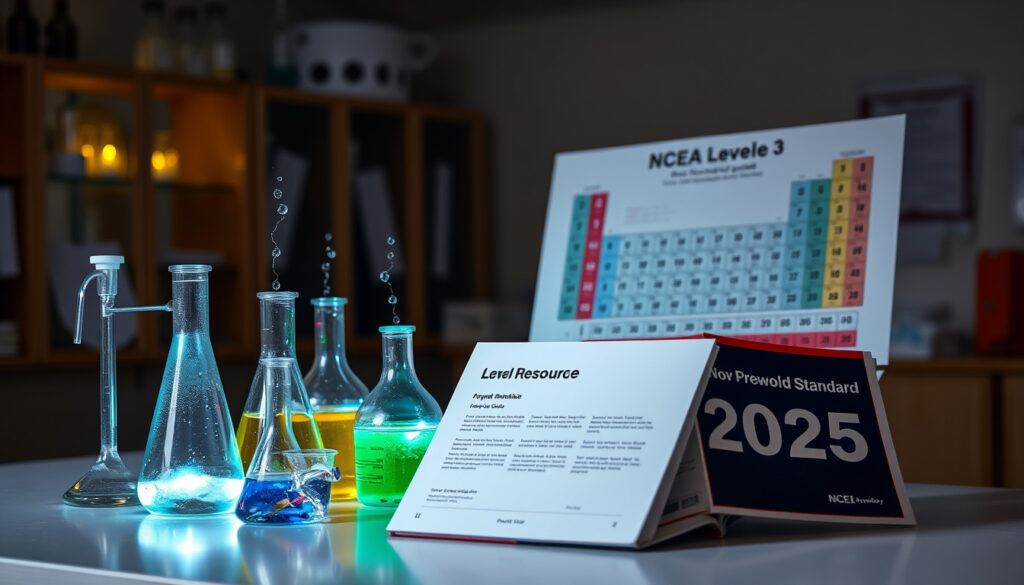
NCEA Level 3 Chemistry – Standards Resources and 2025 Guide
NCEA Level 3 Chemistry represents the culmination of secondary school chemistry study in New Zealand, building upon foundational concepts to explore advanced chemical principles and their real-world applications. This qualification aligns with Level 8 of the New Zealand Curriculum and serves as a critical stepping stone for students pursuing tertiary education in science, engineering, medicine, or related fields.
The course encompasses six main achievement standards spanning topics from thermochemical principles to organic reaction mechanisms. Assessment combines internal practical work with external written examinations, each contributing to the overall grade and potential course endorsement. Understanding the structure, requirements, and available resources can significantly impact student outcomes in this challenging but rewarding subject.
This guide provides a comprehensive overview of the NCEA Level 3 Chemistry syllabus, assessment methods, examination structure, and preparation resources to help students navigate their final year of secondary school chemistry effectively. For students seeking to strengthen their foundational knowledge, exploring NCEA Level 2 Chemistry materials can provide essential groundwork for the advanced concepts introduced at Level 3.
What Are the Achievement Standards for NCEA Level 3 Chemistry?
NCEA Level 3 Chemistry comprises six main achievement standards ranging from AS91387 to AS91392. Each standard focuses on specific advanced topics within chemistry and carries different credit values depending on its complexity and assessment requirements. Students typically study a selection of these standards based on their school’s programme and individual pathway goals.
The standards collectively cover approximately 22-24 available credits, though students may not attempt all of them. Building directly on Level 2 knowledge in chemical analysis, structures, reactions, and equilibrium, these standards demand higher-order thinking and the ability to connect concepts across different areas of chemistry rather than focusing on isolated facts.
The six achievement standards span quantitative analysis, oxidation-reduction chemistry, thermochemical principles, particle properties, organic chemistry, and equilibrium systems. Each standard tests different aspects of chemical understanding at an advanced level.
- AS91387 (3.1, 3 credits): Carry out an independent investigation involving quantitative analysis. This internal standard requires students to design and execute their own practical investigation, collect data, and analyse results to draw valid conclusions.
- AS91388 (3.2, 3 credits): Demonstrate understanding of chemical reactivity and oxidation-reduction reactions. Students explore redox chemistry, electrochemical cells, and the transfer of electrons in chemical processes.
- AS91390 (3.4, 5 credits): Demonstrate understanding of thermochemical principles and the properties of particles and substances. This external standard examines enthalpy changes, entropy, bonding models, and periodic trends.
- AS91391 (3.5, 4 credits): Demonstrate understanding of chemical reactivity and oxidation-reduction processes. This external standard focuses on organic chemistry including reaction mechanisms, functional groups, and stereochemistry.
- AS91392 (3.6, 5 credits): Demonstrate understanding of equilibrium principles in aqueous systems. Students analyse equilibrium constants, solubility, acid-base reactions, and titration calculations.
Core Topics Covered in the Syllabus
The Level 3 Chemistry syllabus places significant emphasis on applying understanding rather than simple recall. Students must demonstrate mastery of interconnected concepts and be able to justify their reasoning using chemical principles. Key topic areas include drawing and interpreting Lewis structures, predicting molecular shapes and polarity, explaining entropy changes in chemical systems, analysing periodic trends including shielding effects, performing calorimetry calculations, completing multi-step organic reaction schemes, and solving equilibrium calculations involving solubility products and titration data.
The external examinations particularly test students’ ability to link structure to properties and to complete comprehensive multi-step reaction pathways. Recent assessment reports indicate that students who can articulate their reasoning clearly and show working in calculations consistently achieve higher grades than those who provide correct answers without justification.
| Standard Code | Standard Title | Credits | Assessment Type |
|---|---|---|---|
| AS91387 | Quantitative Analysis Investigation | 3 | Internal |
| AS91388 | Oxidation-Reduction Reactions | 3 | External |
| AS91390 | Thermochemical Principles and Particle Properties | 5 | External |
| AS91391 | Organic Chemistry and Oxidation-Reduction | 4 | External |
| AS91392 | Equilibrium Principles in Aqueous Systems | 5 | External |
2025 brought revised achievement standards and supporting materials following the annual review process. Schools received updated resources and assessment specifications to reflect these changes, which were implemented across all participating institutions.
How Is NCEA Level 3 Chemistry Assessed?
Assessment in NCEA Level 3 Chemistry combines internal practical work with external written examinations. The internal assessments typically occur throughout the school year, allowing students to demonstrate their practical and investigative skills in a supervised environment. External examinations take place at the end of the year and test theoretical understanding across the three main external standards.
The external examinations run for three hours and include a resource booklet containing essential reference materials, including the periodic table. Students are expected to use this information alongside their knowledge to answer questions spanning multiple difficulty levels. The assessment is designed to distinguish between different levels of understanding, from basic factual recall to sophisticated application and justification.
Grade Expectations and Performance Criteria
Each external examination question is marked against specific criteria that correspond to Achievement, Merit, and Excellence grades. Understanding these expectations helps students target their preparation effectively and focus on developing the skills needed for their desired grade level.
Achievement level requires students to demonstrate basic understanding by drawing Lewis structures correctly, naming molecular shapes, recognising entropy and disorder changes, completing straightforward calculations and reaction steps, and identifying functional groups. Merit level demands deeper engagement, including linking structures to properties, completing most steps in multi-step reactions, and explaining trends using evidence. Excellence level expects comprehensive responses that justify spontaneity by considering both system and surroundings, demonstrate full multi-step pathways with appropriate reagents, show precise calculations with correct units and significant figures, and provide thorough, coherent explanations throughout.
Recent assessment reports highlight that common weaknesses include insufficient depth in explaining entropy spontaneity, difficulty visualising multi-step organic pathways, and misconceptions regarding shielding effects in periodic trends. Students who struggled often provided correct final answers without demonstrating the reasoning process required for higher grades.
Internal Assessment Requirements
The internal standard AS91387 involves conducting an independent quantitative analysis investigation. Schools use approved resources from TKI, including versions like 3.1A v2 and 3.2A/B with associated data files. Students must carry out authentic practical work and modify contexts to ensure original outcomes rather than simply replicating known results.
Practical investigations require careful planning, precise data collection, statistical analysis, and critical evaluation of methods and results. Students must demonstrate their ability to work independently while following proper laboratory protocols and safety procedures. Schools assess these competencies through observation, written reports, and analysis of experimental data.
Where to Find Resources and Past Papers for NCEA Level 3 Chemistry?
Access to quality resources significantly influences student preparation and confidence. Several official and supplementary sources provide valuable materials for both teachers and students studying NCEA Level 3 Chemistry. These resources range from official examination papers to community-contributed study guides and practice materials.
The New Zealand Qualifications Authority maintains the primary repository of official assessment materials. Students can access past examination papers, assessment reports with detailed feedback, and annotated exemplars showing successful student responses at each grade level. These materials offer the most accurate representation of examination expectations and marking criteria.
Official NZQA Resources
The NZQA assessment search provides direct access to all Level 3 Chemistry files including standards specifications, examination papers, and assessment reports. The 2025 examination papers and corresponding reports are available for all external standards, offering insight into question formats and common response patterns observed across the cohort.
The TKI Chemistry resources page contains approved internal assessment materials, teaching guides, and exemplars for internally assessed standards. Teachers can access these resources to support student learning and authentic assessment design.
Assessment reports for AS91390, AS91391, and AS91392 provide detailed breakdowns of question performance and common errors. These reports identify areas where students performed well, such as molecular shapes and polarity questions, and topics requiring additional attention, including entropy justification and shielding effects in periodic trends.
Effective preparation combines official past papers with assessment report analysis. Students should work through examination papers under timed conditions, then study the corresponding reports to understand marking expectations and common pitfalls.
Practice Exams and Study Guides
The New Zealand Institute of Chemistry offers practice examination sets for Year 13 students covering AS91390, AS91391, and AS91392, along with scholarship-level practice materials. These resources are primarily distributed through schools and require teacher access rather than direct student purchase.
School-based study guides provide additional support tailored to specific course requirements. Many schools offer workbooks covering multiple standards with both practical and written assessment preparation. These materials often include examination-style questions, worked examples, and key concept summaries designed to reinforce learning.
Supplementary video resources including informal examination walkthroughs can provide additional practice opportunities. While these informal resources should not replace official materials, they can help students familiarise themselves with examination techniques and common question structures.
Is NCEA Level 3 Chemistry Hard and What Are the Prerequisites?
NCEA Level 3 Chemistry carries a reputation for significant challenge, requiring students to develop sophisticated analytical skills and demonstrate deep conceptual understanding. Success demands more than memorisation; students must synthesise information across topics, justify reasoning with evidence, and apply principles to novel situations encountered in examinations.
The standard prerequisite is a minimum of 12 credits in Level 2 Chemistry, though individual schools may set additional entry requirements based on their assessment of student readiness. Students without this foundation often struggle with the accelerated pace and abstract concepts introduced at Level 3. Those considering this qualification should review our comprehensive Level 2 Chemistry guide to ensure they have the necessary preparation. If you’re looking to build a strong foundation, reviewing our comprehensive Level 2 Chemistry guide, which includes information on Stranger Things Season 2, is highly recommended.
Difficulty Factors and Student Challenges
Several factors contribute to the perceived difficulty of Level 3 Chemistry. The conceptual density increases substantially, requiring students to hold multiple interconnected ideas in mind simultaneously. Multi-step reaction pathways demand understanding of mechanism rather than just outcome, while equilibrium calculations require comfort with algebraic manipulation and approximation techniques.
Assessment reports consistently identify particular challenges in justifying entropy spontaneity by considering both system and surroundings, completing full multi-step organic pathways with correct reagents and conditions, and explaining periodic trends with reference to shielding effects and nuclear charge. Students who develop strong foundational understanding in these areas during earlier levels typically find the transition smoother.
Strong candidates distinguish themselves through precise calculations showing correct units and significant figures, comprehensive responses that address all aspects of questions, and the ability to link structure to properties throughout their explanations. Weaker responses frequently lack the depth and justification required for Merit and Excellence grades.
A scientific calculator is essential for Level 3 Chemistry. Students should ensure they have a suitable calculator well before examinations and familiarise themselves with its functions for equilibrium calculations, logarithm operations, and statistical analysis.
Endorsement Requirements
Course endorsement at Merit or Excellence requires 14 or more credits at that level across internally and externally assessed standards. Individual standard endorsement follows the same credit threshold. The overall course endorsement threshold requires 14 credits at Merit or Excellence representing at least 50% of the course credits attempted.
Achieving endorsement demonstrates consistent high-level performance and can strengthen university applications, particularly for competitive programmes. Students targeting endorsement should plan their assessment schedule carefully, focusing on building strong results across all standards rather than concentrating effort on a few areas.
Preparing for NCEA Level 3 Chemistry Examinations
Effective examination preparation for NCEA Level 3 Chemistry follows a structured timeline across the school year. Beginning early allows students to build conceptual foundations gradually rather than cramming essential knowledge immediately before examinations. Schools typically introduce internal assessments in the first term, with external examination preparation intensifying during the second and third terms.
Practice examinations usually occur mid-year, providing valuable feedback on areas requiring additional attention. Students should use these results to identify specific topics and skill areas needing development rather than viewing practice exams as isolated events. Following practice examinations, targeted review sessions focused on demonstrated weaknesses prove more valuable than re-studying already-mastered content.
- Term 1: Focus on building foundational knowledge and commencing internal assessment preparation. Establish strong understanding of core concepts before attempting application-level questions.
- Mid-Year: Complete practice examinations and analyse results to identify priority areas. Begin systematic review of external standard topics while finalising internal work.
- Term 3: Intensive external examination preparation including past paper practice under timed conditions. Focus on developing examination technique alongside content review.
- October-November: External examinations for all three external standards. Maintain confidence through continued practice while ensuring adequate rest before each examination.
- December: Results released. Review performance to inform future study decisions if needed.
Students should practice drawing reaction mechanisms and equilibrium expressions regularly rather than just reading about them. Active engagement with material through problem-solving builds the procedural fluency needed for examination success.
What Is Established Versus Uncertain About NCEA Level 3 Chemistry?
While the core structure of NCEA Level 3 Chemistry remains stable, certain aspects have been confirmed or updated, while others require monitoring for future changes. Understanding what is firmly established versus what remains subject to revision helps students and teachers plan effectively.
| Established Information | Information Requiring Verification |
|---|---|
| Six main achievement standards (AS91387-91392) covering quantitative analysis, redox, thermochemistry, particles, organic chemistry, and equilibrium | Future curriculum modifications beyond 2025 updates |
| Three external examinations totalling approximately 14 credits | Potential changes to assessment weighting in future years |
| 14 credits at Merit/Excellence required for endorsement | School-specific course structures and standard selections |
| Minimum 12 Level 2 Chemistry credits as prerequisite | Specific examination question formats for upcoming years |
| 2025 revised standards and supporting materials implemented | Availability of supplementary resources through various providers |
Why NCEA Level 3 Chemistry Matters for Future Studies
NCEA Level 3 Chemistry provides essential preparation for tertiary study in chemistry and related disciplines. The skills developed, including systematic analysis, evidence-based reasoning, and quantitative problem-solving, form the foundation for success in university-level science courses. Students planning careers in medicine, engineering, environmental science, pharmacology, or research benefit significantly from strong performance in this qualification.
The course bridges secondary and tertiary education by introducing concepts and skills at an appropriate level of complexity. Students who engage deeply with the material develop transferable skills in scientific thinking and communication that serve them well regardless of their ultimate career path. The emphasis on justification and explanation at Excellence level mirrors expectations in university assessment, making the transition smoother for well-prepared students.
Beyond university preparation, Level 3 Chemistry develops critical thinking skills applicable across many contexts. Understanding chemical principles helps citizens engage with issues involving environmental management, public health, and technological development. The subject’s focus on evidence-based reasoning provides valuable training in evaluating competing claims and making informed decisions.
Success in Level 3 Chemistry requires connecting concepts across topics rather than treating them as isolated facts. Students who can articulate relationships between structure, properties, and reactivity demonstrate the understanding needed for both examination success and future study.
Summary: Key Points About NCEA Level 3 Chemistry
NCEA Level 3 Chemistry encompasses six achievement standards covering advanced topics in analytical chemistry, thermochemistry, organic chemistry, particle properties, equilibrium, and redox processes. Assessment combines internal practical work worth approximately 9 credits with external written examinations totalling around 14 credits. Students require a minimum of 12 Level 2 Chemistry credits as preparation for this challenging but rewarding course.
Official resources from NZQA and TKI provide essential materials including past examination papers, assessment reports, and exemplars. Additional support comes from school-based study guides, NZIC practice examinations, and supplementary video resources. Effective preparation combines thorough content understanding with examination technique development through regular practice under timed conditions.
Course endorsement requiring 14 Merit or Excellence credits rewards consistent high performance across the qualification. Students who develop strong skills in justifying reasoning, completing multi-step pathways, and linking structure to properties position themselves well for both examination success and future tertiary study in chemistry and related fields. For additional educational resources, see our guide on What Is Renewable Energy – Definition, Types, Benefits.
Frequently Asked Questions
How many credits are needed for NCEA Level 3 Chemistry endorsement?
Course endorsement at Merit or Excellence requires 14 or more credits at that level across all assessed standards, with the Merit/Excellence credits representing at least 50% of total course credits. Individual standard endorsement follows the same threshold of 14 credits at Merit or Excellence within that standard.
Are there changes to NCEA Level 3 Chemistry in 2025?
Yes, 2025 introduced revised achievement standards and supporting materials following the annual review process. Schools received updated resources and assessment specifications to reflect these changes, which were implemented across participating institutions. Students should ensure they are using current materials rather than outdated resources.
What topics are covered in the NCEA Level 3 Chemistry external exams?
The three external examinations cover thermochemical principles and particle properties (AS91390), organic chemistry and oxidation-reduction processes (AS91391), and equilibrium principles in aqueous systems (AS91392). Topics include Lewis structures, molecular polarity, entropy, periodic trends, calorimetry, functional groups, reaction mechanisms, and equilibrium calculations.
Can I study Level 3 Chemistry without completing Level 2?
The standard prerequisite is a minimum of 12 credits in Level 2 Chemistry. While it may be theoretically possible to enter without this foundation, students typically find the conceptual demands overwhelming without prior knowledge. Schools may have additional entry requirements based on their assessment of student readiness.
How long are the NCEA Level 3 Chemistry external examinations?
Each external examination runs for three hours. Students receive a resource booklet containing the periodic table and other reference information. The examinations test Achievement, Merit, and Excellence levels through questions requiring basic understanding, in-depth application, and comprehensive justification respectively.
What is the best way to prepare for the Level 3 Chemistry internal assessment?
Effective preparation involves thoroughly understanding the investigation requirements, practicing quantitative analysis techniques, and developing data analysis skills. Schools provide approved resources through TKI including data files and assessment guides. Students should ensure their investigation demonstrates authentic independent work with modified contexts.
More related posts
 Old Fashioned Tomato Relish Recipe NZ: Authentic Guide
 Houses for Sale in Beachlands: Prices, Listings & Tips
 Sport & Recreation Jobs – No College Degree Needed
 Portrait of a Lady Perfume Guide: Scent, Celebrities & Dupes
 Best Cherry Red Hair Dye: Permanent for Dark Hair & Reviews
 Cast of F1 (Film) 2025: Brad Pitt, Damson Idris, and More
 UEFA Women’s EURO 2025: Favourites, Winners & Prize Money
 Build-A-Bear Christchurch: Locations, Prices & Tips