When Harry Met Sally – Plot, Cast, Diner Scene Guide
When Harry Met Sally… arrived in theaters on July 21, 1989, and immediately redefined the romantic comedy genre. Directed by Rob Reiner and written by Nora Ephron, the film stars Billy Crystal and Meg Ryan as two University of Chicago graduates whose relationship evolves over twelve years, testing the boundaries between friendship and romance against the backdrop of New York City.Source
The story hinges on one provocative question: can men and women ever truly be just friends? Harry Burns argues no, insisting sex always interferes, while Sally Albright maintains otherwise. Their debates, chance encounters, and eventual friendship drive a story that grossed over $92 million domestically on a modest $16 million budget, cementing its status as a cultural touchstone.
Three decades later, the film’s sharp dialogue, iconic deli scene, and Harry’s midnight New Year’s Eve confession remain embedded in popular consciousness. Its exploration of vulnerability, timing, and companionship continues to influence romantic comedies, earning a 94% approval rating on Rotten Tomatoes.Source
What Is When Harry Met Sally About?
Rob Reiner
Meg Ryan, Billy Crystal
1989
96 minutes
The film traces the relationship between Harry Burns and Sally Albright from their initial meeting in 1977 through 1989. After graduating from the University of Chicago, they share a tense car ride to New York City, where Harry introduces his theory that heterosexual friendship inevitably succumbs to sexual tension.
The narrative structure employs several distinctive techniques:
- The 12-year timeline allows for realistic character evolution rather than instant attraction.
- Documentary-style interviews with real elderly couples punctuate the narrative, providing counterpoint to Harry and Sally’s skepticism.
- The screenplay inverts traditional rom-com formulas by establishing friendship before romance.
- Reiner and Ephron utilized actual taped conversations between friends to craft authentic dialogue.
- The title derives from a Louis Armstrong lyric: “Do you remember when Harry met Sally?”
- The film’s R rating (later frequently edited for television) reflected frank discussions of sexuality rare in mainstream comedies of the era.
| Attribute | Details |
|---|---|
| Genre | Romantic Comedy |
| Release Date | July 21, 1989 |
| Budget | $16 million |
| Box Office | $92 million+ |
| Screenplay | Nora Ephron |
| Cinematography | Barry Sonnenfeld |
Who Stars in When Harry Met Sally?
Billy Crystal as Harry Burns
Crystal portrays a cynical divorcé turned sportswriter whose biting wit masks deep-seated romantic anxiety. His performance balances sarcasm with vulnerability, particularly during the film’s climactic confession scene. Reiner selected Crystal specifically because of their real-life friendship, allowing for improvisational chemistry that shaped several scenes.Source
Meg Ryan as Sally Albright
Ryan embodies an optimistic journalist with meticulously ordered habits, creating a foil to Harry’s chaos. The role required Ryan to bleach her hair blonde and undergo extensive comedic timing rehearsals. Her portrayal of Sally’s dating rules and emotional specificity established the “quirky romantic lead” archetype that defined 1990s cinema.
Carrie Fisher and Bruno Kirby
Fisher appears as Marie, Sally’s pragmatic best friend who falls for Harry’s friend Jess, played by Kirby. Their parallel romance demonstrates the film’s thesis that friendship can successfully transition to marriage when both parties share intentions, contrasting with Harry and Sally’s prolonged ambiguity.
Reiner initially conceived the project while processing his own divorce, conducting taped conversations with female friends to explore male-female dynamics. These recordings formed the basis of Ephron’s screenplay, with Crystal brought in early to refine dialogue based on actual friendship patterns.
What Is the Famous Diner Scene?
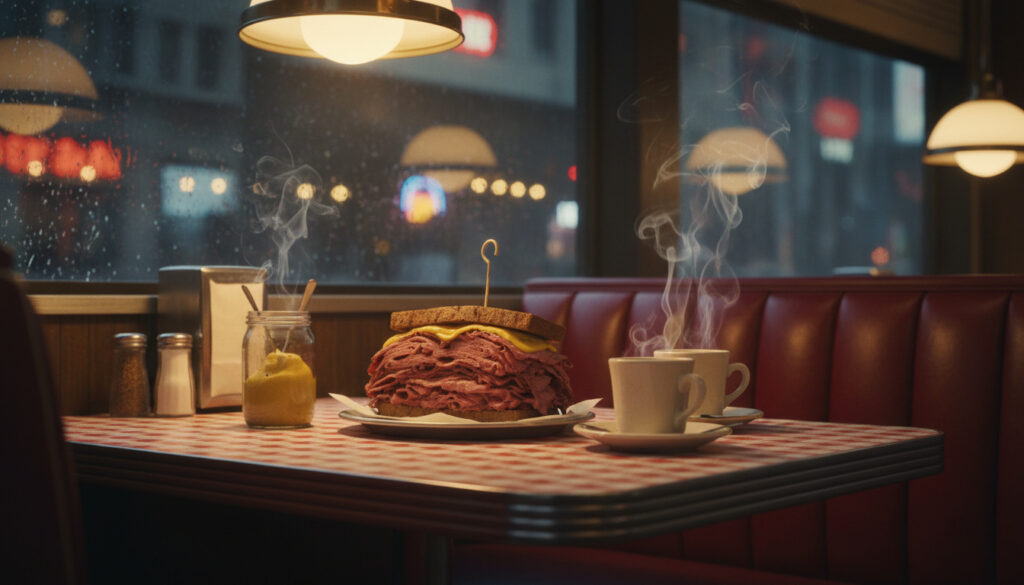
The Katz’s Delicatessen Moment
During their 1977 road trip, Harry and Sally stop at a diner where Harry demonstrates his theory that women fake orgasms. The scene later culminates in 1989 at Katz’s Delicatessen on Manhattan’s East Houston Street, where Sally proves her point through a theatrical demonstration while eating a sandwich.Source
“I’ll Have What She’s Having”
Following Ryan’s performance, director Rob Reiner’s mother, Estelle Reiner, delivered the film’s most quoted line: “I’ll have what she’s having.” The line was entirely improvised during filming. The scene required over twenty takes, with Ryan performing the fake orgasm repeatedly while Crystal remained unaware of exactly how she would play the moment, ensuring genuine reactions.
The exterior of Katz’s Delicatessen remains largely unchanged since 1989, though the interior layout shifted slightly. The table where Ryan and Crystal sat now holds a plaque commemorating the scene, making it one of New York’s most photographed restaurant locations.
Defining Dialogue
The film’s quotability extends throughout the script. Harry’s opening assertion that “men and women can’t be friends because the sex part always gets in the way” establishes the central conflict. Sally’s retort regarding her “strict policy: no sex until after the third date” demonstrates their opposing worldviews. The screenplay’s density of memorable lines contributed to its Writers Guild of America recognition.
Is When Harry Met Sally Based on a True Story?
The Real-Life Inspiration
While not directly adapted from specific true events, the screenplay emerged from Ephron’s interviews with Reiner following his divorce from Penny Marshall. Reiner explored whether his new platonic friendship with a woman could remain strictly non-romantic, providing the film’s central tension. Ephron incorporated elements from her own observations of couples and dating patterns in 1980s Manhattan.Source
Primary Filming Locations
The production utilized authentic New York locations to ground the story in recognizable reality. Key sites included:
- Katz’s Delicatessen: The iconic orgasm scene location on the Lower East Side.
- University of Chicago: Exteriors establishing the 1977 graduation sequences.
- Shakespeare & Company: The bookstore where Harry and Sally reconnect in 1987.
- Temple of Dendur: The Metropolitan Museum of Art wing hosting Jess and Marie’s wedding.
- Central Park: Multiple seasonal sequences showing the passage of time.
Despite rumors suggesting Harry and Sally represent Reiner and Marshall specifically, Ephron maintained the characters were composites. The twelve-year timeline compresses and alters real events, and the specific dialogue exchanges were written for maximum comedic effect rather than documentary accuracy.
The title references Louis Armstrong’s recording of “What a Wonderful World,” specifically the spoken introduction where Armstrong asks, “Do you remember when Harry met Sally?” Ephron selected it to evoke nostalgia and the sense of destiny the film explores.
When Did Production and Release Occur?
- 1982: Nora Ephron begins interviewing Rob Reiner about his post-divorce experiences, developing the screenplay treatment.Source
- 1987: Final script approval with Crystal attached to star; pre-production begins in New York.
- Late 1987-1988: Principal photography occurs across four seasons to show chronological progression.
- July 21, 1989: Theatrical release in the United States by Columbia Pictures.
- 1990: Golden Globe nominations for Crystal and Ryan; BAFTA nomination for Ephron’s screenplay.
- 2004: Added to the National Film Registry for preservation by the Library of Congress.
- 2019-Present: 30th anniversary screenings and continued availability via streaming platforms.
What Are the Verified Facts Versus Popular Myths?
| Established Information | Information That Remains Unclear |
|---|---|
| Screenplay inspired by Reiner’s post-divorce friendship dynamics | Whether specific dialogue exchanges occurred verbatim in real life |
| Estelle Reiner improvised the “I’ll have what she’s having” line | The precise number of takes required for the diner scene (reports vary between 20 and “numerous”) |
| Ryan performed the fake orgasm without informing Crystal of specifics | Whether the studio initially resisted the R-rated frankness of the dialogue |
| Crystal ad-libbed substantial portions of dialogue | The exact percentage of improvised versus scripted material in the final cut |
Why Does When Harry Met Sally Still Resonate?
The film’s durability stems from its honest examination of how adult relationships develop through accumulated shared experience rather than immediate chemistry. Unlike contemporaneous romantic comedies that relied on mistaken identity or deceptive premises, Harry and Sally’s connection builds through late-night phone calls, supportive friendship during breakups, and gradual recognition of compatibility.
The 1989 release also captured a specific cultural moment regarding changing gender roles and professional single life in urban America. Sally’s career as a journalist and Harry’s transition from political consultant to sportswriter reflected shifting economic realities for middle-class professionals. The film treats these characters’ ambitions seriously while exploring how those ambitions intersect with loneliness.
Modern analyses note the film’s complex legacy regarding consent and agency. Some critics interpret Harry’s final New Year’s Eve declaration as responding to Sally’s withdrawal, potentially framing romance as an ultimatum rather than mutual selection.Source This ambiguity allows contemporary viewers to engage with the text through evolving social frameworks while appreciating its technical craftsmanship.
What Did the Filmmakers and Characters Say?
“I love that you get cold when it’s 71 degrees out. I love that it takes you an hour and a half to order a sandwich. I love that you are the last person I want to talk to before I go to sleep at night… When you realize you want to spend the rest of your life with somebody, you want the rest of your life to start as soon as possible.”
— Harry Burns (Billy Crystal)
“Men and women can’t be friends because the sex part always gets in the way.”
— Harry Burns
“I’ll have what she’s having.”
— Delicatessen patron (Estelle Reiner)
The Enduring Appeal of When Harry Met Sally
When Harry Met Sally… remains the definitive romantic comedy through its refusal to accept easy answers about human connection. The film argues that friendship forms the strongest foundation for romance while acknowledging the risks inherent in crossing that boundary. Like the Fellowship of the Ring – Complete Guide to Members, Plot and Differences examines bonds between travelers, this film explores how shared journeys create unbreakable ties. Its legacy persists not merely in quoted lines or tourist visits to Katz’s Deli, but in its template for depicting intelligent adults navigating vulnerability with humor.
Frequently Asked Questions
Why is When Harry Met Sally considered the perfect romantic comedy?
The film balances genuine emotional stakes with sharp wit, allowing characters to develop over twelve years rather than forcing instant attraction. Ephron’s screenplay treats both leads as fully realized professionals with distinct worldviews, creating a template that subsequent romantic comedies continue to emulate.
What was the first meeting scene between Harry and Sally?
They meet in 1977 after graduating from the University of Chicago, sharing an 18-hour car ride to New York where Harry argues that sex prevents male-female friendships, offending Sally with his bluntness and leading to an awkward diner stop.
Did Meg Ryan really fake the orgasm in the diner scene?
Yes, Ryan performed the scene without body doubles, requiring over twenty takes to capture various angles. Director Rob Reiner instructed her to simulate the act while Billy Crystal remained unaware of exactly how she would perform, ensuring his reactions appeared genuine.
How long did it take for Harry and Sally to get together?
The narrative spans twelve years from their 1977 meeting to their 1988 New Year’s Eve reconciliation. They marry three months after the final kiss, as revealed in the closing scene showing them being interviewed as a married couple.
What song is the title When Harry Met Sally from?
Writer Nora Ephron selected the title from Louis Armstrong’s spoken introduction to “What a Wonderful World,” in which Armstrong asks, “Do you remember when Harry met Sally?” The reference evokes nostalgia and destiny.
Where can I find similar comedy content?
For additional sharp wit and adult humor comparable to Crystal and Ryan’s banter, see Funny Jokes for Adults – Hilarious One-Liners and Puns.
More related posts
 West End Schnapper Bar Whangārei: Menu, Photos, Delivery
 What Is Open on Good Friday 2026? Ireland & UK Guide
 Orbit 360° Dining Menu: Prices, Dress Code & Parking
 How Long Does SHEIN Take to Ship to NZ – Times, Costs and Couriers
 Warriors v Dolphins NRL Auckland Clash: Score, Tickets, Teams
 Google TV Streamer 4K Review: Worth the Upgrade
 Chi Lewis-Parry: Age, Height, Career, and Personal Life
 X-Men: Dark Phoenix – Why It Flopped, Hit or Bomb, and Its Impact