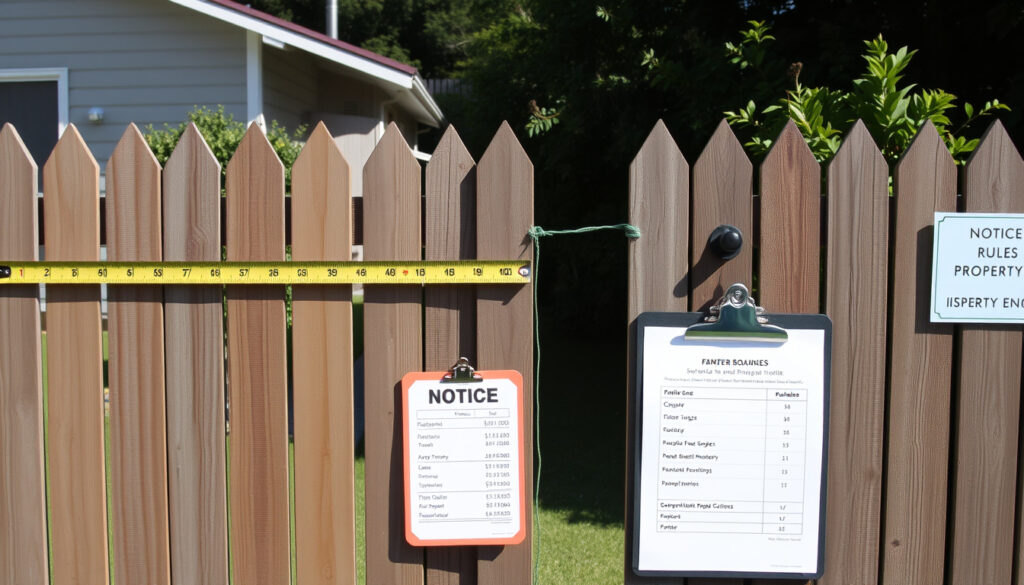
Boundary Fence Rules NZ: Height, Costs & Disputes Guide
Few things test neighbourly goodwill quite like a boundary fence dispute. Under the Fencing Act 1978, both neighbours usually share the cost – but the rules around height, placement, and even leaning a ladder against the fence can get tricky fast.
Maximum fence height without consent: 2.5 metres ·
Default cost sharing percentage: 50/50 ·
Fencing notice required before work: Yes, under the Fencing Act 1978 ·
Council height variation possible: Yes, check local rules
Quick snapshot
- Maximum height 2.5m under Building Act unless council specifies otherwise (The Rural (farming guidance))
- Cost sharing is mandatory for adequate fences (Community Law (legal resource))
- A fence on the boundary is typically owned jointly (Consumer NZ (consumer advocacy))
- Whether trellis counts toward height limit varies by council
- Whether leaning objects are considered ‘attachment’ under law
- Exact enforcement of cost sharing if neighbour refuses
- Whether a fence entirely on one property can be removed without consent
- Whether a retaining wall counts as a fence under the Act
- No fixed statutory timeline for cost-sharing disputes; Disputes Tribunal process varies (Disputes Tribunal (government body))
- Serve a fencing notice to activate cost-sharing obligations (Consumer NZ, consumer advocacy)
Five key numbers, one pattern: the law sets clear defaults but leaves room for negotiation.
| Parameter | Value |
|---|---|
| Maximum fence height (without consent) | 2.5 metres |
| Cost sharing default | 50/50 for adequate fence |
| Fencing notice required | Yes, under Fencing Act 1978 |
| Neighbour response time | 21 days |
| Disputes body | Disputes Tribunal or District Court |
What is the maximum height for a boundary fence in NZ?
Can my neighbour put up a 7 foot fence?
- In most cases, a fence can be up to 2.5 metres (approx 8.2 feet) without resource consent (The Rural, farming guidance). A 7-foot fence (2.13 metres) is well within that limit.
- However, councils can set stricter limits – for example, some require consent for fences above 1.8 metres in front yards. Always check your district plan (Consumer NZ (consumer advocacy)).
What Is the Maximum Height for a Garden Fence With Trellis?
- The Building Act 2004 requires building consent for any fence over 2.5 metres, including the trellis (The Rural (farming guidance)).
- Some councils treat trellis as part of the fence height; others allow extra trellis as long as the solid part is under 2.5 metres. This is a grey area (Consumer NZ, consumer advocacy).
The implication: height restrictions are clear in law but fuzzy in practice due to council variations. The safest move is to ask your local council before spending money.
Can my neighbour remove a boundary fence?
Can a Neighbour Move My Fence? Fence Ownership and Boundary
- Under the Fencing Act 1978, a neighbour cannot remove a boundary fence without agreement or a fencing notice (Community Law (legal resource)).
- If the fence sits on the boundary, ownership is shared – both parties must consent to removal or relocation (Consumer NZ, consumer advocacy).
- A fence entirely on one neighbour’s property can potentially be removed by that owner, but they may still owe a duty to maintain adequate fencing if it serves as a boundary fence (Community Law, legal resource).
Removing a boundary fence without permission can lead to a court order to rebuild and a costs claim. For homeowners on either side, the rule is simple: no unilateral removal. Get written agreement first, or serve a fencing notice.
The pattern: shared ownership means shared veto rights. Even if you own the fence outright, removing it can create a legal problem if it leaves the neighbour’s property exposed.
Can my neighbour attach things to my fence in NZ?
Is my neighbour allowed to lean things against my fence?
- Leaning objects without permission can be considered trespass or nuisance, especially if they cause damage (Consumer NZ, consumer advocacy).
- If the fence is solely owned, the owner can prohibit any attachments (Rainey Collins (law firm)).
Can my neighbour nail and screw to my garden fence?
- Attaching items by nailing or screwing without permission may constitute damage, even if the fence is shared (Rainey Collins, law firm).
- For a shared fence, both parties have rights – but using it as a storage wall requires agreement (Community Law, legal resource).
The trade-off: you can usually paint your own side of a shared fence without objection, but drilling, screwing, or leaning heavy items against the fence crosses a line. If your neighbour is blocking your fence, a polite written request to remove the items followed by a legal notice if needed is the correct path.
Does your neighbour have to pay for half a fence in NZ?
Is it normal to split the cost of a fence?
- Yes – under the Fencing Act 1978, both neighbours must share the cost of an ‘adequate’ boundary fence equally, unless an exception applies (Community Law, legal resource).
- If one party insists on a higher‑spec fence (e.g., decorative panels instead of standard wire), they may have to pay the extra cost (Consumer NZ (consumer advocacy)).
How to Ask a Neighbor to Share Fence Costs
- The correct first step is to serve a fencing notice in writing. It must describe the work, materials, estimated cost, and a start date (Community Law (legal resource)).
- The neighbour has 21 days to respond. If they agree, cost‑sharing is enforced. If they refuse or ignore the notice, you can apply to the Disputes Tribunal (Disputes Tribunal (government body)).
The Fencing Act’s cost‑sharing rule applies only if you serve a proper notice before starting work. A neighbour cannot be forced to pay half if you build first and ask later. Homeowners initiating a fence: draft a clear fencing notice before ordering materials.
The bottom line on cost: half‑share is the default, but you must follow the notice procedure to claim it. Upgrading the fence beyond “adequate” means you foot the extra bill.
How close to my property line can my neighbor build a fence?
What does the Fencing Act say about fence placement?
- A boundary fence should be placed on the boundary line or as near as practicable. If there are no posts, the middle of the fence should align with the boundary (Consumer NZ, consumer advocacy).
- If the boundary is uncertain, a registered surveyor must determine the line before building (Consumer NZ, consumer advocacy).
- A fence built entirely on one owner’s property is that owner’s sole responsibility, but it must still comply with council height and setback rules (The Rural (farming guidance)).
The pattern: the law encourages fences to sit on the boundary line to avoid wasting land. Building slightly inside your own boundary is allowed, but you cannot then expect the neighbour to share the cost of the fence.
Upsides and downsides of NZ’s boundary fence rules
Upsides
- Clear statutory framework under the Fencing Act 1978 reduces guesswork.
- Mandatory cost‑sharing prevents a neighbour from blocking a necessary fence.
- Disputes Tribunal offers a low‑cost resolution path.
Downsides
- Requires a formal fencing notice before cost‑sharing is enforceable.
- Council height variations create confusion.
- Disputes can still drag on if neighbours are uncooperative.
Step‑by‑step: How to resolve a boundary fence dispute
- Check the boundary. Use your title plan or hire a registered surveyor to confirm the exact line (Consumer NZ, consumer advocacy).
- Decide on the fence. Determine the type, materials, and total cost. An ‘adequate’ fence is typically the default – anything fancier may be at your own cost (The Rural, farming guidance).
- Serve a fencing notice. Write to your neighbour including your names, the proposed work, estimated cost, materials, start date, and a reference to the Fencing Act 1978 (Community Law, legal resource).
- Wait 21 days. The neighbour has 21 days to respond. If they agree, you can proceed and split costs. If they do nothing, you can apply to the Disputes Tribunal (Disputes Tribunal (government body)).
- Build or escalate. Once agreement or tribunal order is obtained, build the fence. Keep all receipts and records (Consumer NZ, consumer advocacy).
Clearing up the fence confusion
Confirmed facts
- Maximum height 2.5m under Building Act unless council specifies otherwise.
- Cost sharing is mandatory for adequate fences.
- A fence on the boundary is typically owned jointly.
- Fencing notice is required to enforce cost sharing.
What’s unclear
- Whether trellis counts toward height limit varies by council.
- Whether leaning objects are considered ‘attachment’ under law.
- Exact enforcement of cost sharing if neighbour refuses.
- Whether a fence entirely on one property can be removed without consent.
- Whether a retaining wall counts as a fence under the Act.
What the experts say
“Your neighbour can’t put up a fence, or upgrade an existing fence, without your permission.”
– Consumer NZ (consumer advocacy)
“The occupiers of adjoining properties must share the cost of work on boundary fences.”
– Fencing Act 1978, Section 9 (New Zealand legislation (government))
“If intending to fence, consent from the neighbour is required.”
– Community Law (legal resource)
For New Zealand homeowners, the choice is clear: follow the fencing notice process before spending money, or risk being out of pocket. The Fencing Act 1978 gives a solid legal framework, but it only protects those who use it correctly. Know your boundary, put it in writing, and keep the peace.
Related reading: Pink Batts Wall Insulation – R-Values, Installation & Costs Guide
Frequently asked questions
What is an adequate fence under the Fencing Act?
An adequate fence is one that is reasonably sufficient for the circumstances. The Act provides suggested types for rural settings (e.g., 7- or 8-wire fences), but for urban properties it generally means a fence that provides privacy and security typical for the area (The Rural, farming guidance).
Can I remove a fence if I own it outright?
If the fence lies entirely on your property and no one else relies on it for enclosure, you can remove it. But if it serves as a boundary fence (even if on your side), you may need to replace it with an adequate one (Community Law, legal resource).
What happens if a neighbour refuses to pay half the fence cost?
If you served a valid fencing notice and the neighbour does not respond within 21 days, you can apply to the Disputes Tribunal for an order requiring them to pay their share (Disputes Tribunal (government body)).
Do I need building consent for a fence?
Building consent is required for fences over 2.5 metres in height. Retaining walls over 1.5 metres also need consent. Check with your local council for any additional rules (The Rural, farming guidance).
Can I paint my side of a boundary fence?
Yes, painting your side of a shared fence is generally permissible as long as you do not damage the fence. If the fence is owned solely by your neighbour, ask permission first (Consumer NZ, consumer advocacy).
How long does a fencing notice remain valid?
The notice itself does not expire, but it is best to start work within a reasonable time (e.g., 3–6 months) to avoid confusion. If circumstances change, serve a new notice (Community Law, legal resource).
More related posts
 PlayBattleSquare Blog Guide: Minecraft, FPS & Hardware
 What Does a Heart Attack Feel Like – Symptoms in Men and Women
 South Africa National Cricket Team: History, Stats & FAQs
 Dad Jokes for Adults: Funny, Flirty & One-Liner Jokes
 Cordell Sum Sure Calculator – Rebuild Cost Guide for Homeowners
 TJ’s Kitchen St Andrew Street Invercargill Menu & Prices
 Oldest Country in the World: Iran, Egypt, or China?