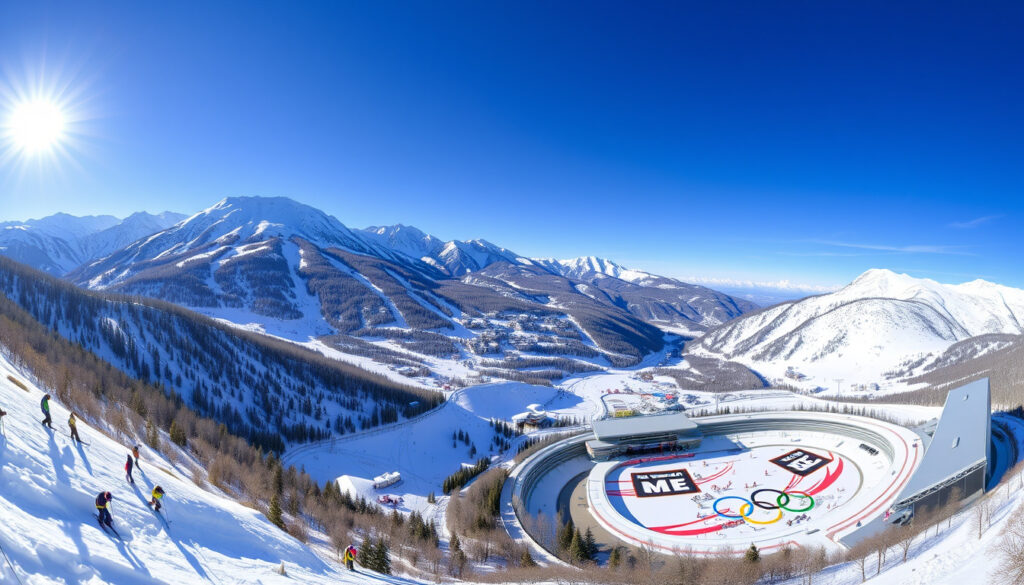
2026 Winter Olympics: Host Cities, Schedule and Updates
The 2026 Winter Olympics return to the European Alps after consecutive Asian editions, but Italy’s two-city model — spreading events across 22,000 square kilometres — makes this the most decentralized Winter Games ever staged. Here is what you need to know about the dates, venues, participating countries, and what comes next for the Olympic movement.
Official name: XXV Olympic Winter Games ·
Host cities: Milan and Cortina d’Ampezzo, Italy ·
Dates: 6–22 February 2026 ·
Opening ceremony venue: San Siro, Milan ·
Closing ceremony venue: Arena di Verona, Verona ·
Number of medal events: 116
Quick snapshot
- Host city elected: 24 June 2019 (IOC Session)
- First venue ready: Livigno Aerials & Moguls Park, Dec 2024 (Wikipedia)
- Construction on new ice hockey arena started Nov 2023 (Wikipedia)
- 2028 Winter Youth Olympics host selection pending (IOC)
- 2030 Winter Olympics host expected to be decided soon (Wikipedia)
- Salt Lake City likely to host 2034 Winter Olympics (Wikipedia)
The facts in this table reveal a pattern: the Games are built on an unprecedented geographic scale with a strong sustainability mandate.
| Category | Value |
|---|---|
| Official name | XXV Olympic Winter Games |
| Host cities | Milan and Cortina d’Ampezzo, Italy |
| Dates | 6–22 February 2026 |
| Opening ceremony venue | San Siro, Milan |
| Closing ceremony venue | Arena di Verona, Verona |
| Number of sports | 15 |
| Number of medal events | 116 |
| Election date | 24 June 2019 |
| Previous Winter Games in Italy | 1956 Cortina, 2006 Turin |
Where will the 2026 Winter Olympics be held?
What are the main venues in Milan?
- San Siro: opening ceremony venue (Wikipedia)
- Milano Santagiulia Ice Hockey Arena: ice hockey and para ice hockey (Wikipedia)
- Milano Ice Skating Arena: figure skating and short track (ESPN)
The Milan cluster houses four competition venues for four Olympic sports and one Paralympic sport. Construction on the new Santagiulia arena began on 28 November 2023, with initial estimates around €180 million, later revised upward by €70–90 million due to rising costs (Wikipedia).
What are the main venues in Cortina d’Ampezzo?
- Anterselva Biathlon Arena: biathlon, capacity 19,000 (ESPN)
- Alpine skiing courses on the slopes of Tofane and Cortina
- Bobsleigh, luge, and skeleton track (refurbished from 1956)
How are the two cities connected?
The venues span more than 22,000 square kilometres across four clusters in northern Italy — Lombardy, Veneto, Trentino, and South Tyrol — connected by high-speed rail and road networks (Wikipedia).
Over 90% of the 25 venues are pre-existing or temporary, a deliberate move to keep costs in check and align with the IOC’s sustainability agenda (Wikipedia).
The geographic sprawl — the most decentralized Winter Olympics ever — means spectators face long travel between venues. The promise of sustainability clashes with the carbon cost of moving thousands of fans across 22,000 square kilometres.
The implication: Italy’s two-city model is a deliberate experiment. If it succeeds logistically, it could reshape how the IOC evaluates future bids — favouring region-wide clusters over single-city mega-projects.
When are the 2026 Winter Olympics and what is the schedule?
What are the exact dates of the 2026 Winter Olympics?
The Games run from 6 to 22 February 2026 (Wikipedia).
When is the opening ceremony?
The opening ceremony takes place on 6 February at San Siro in Milan. Preliminary competitions in curling and ice hockey start as early as 4 February (Wikipedia).
What is the competition schedule for key sports?
- 16 days of competition with medal events daily
- Alpine skiing: first medals awarded on 7 February
- Biathlon: competitions at Anterselva from 8 February
- Figure skating finals: second week of the Games
- Closing ceremony: 22 February at Arena di Verona (Roadtrips)
Early preliminaries before the opening ceremony mean some athletes compete before the Games officially begin, which dilutes the ceremonial impact for those events.
The trade-off: early preliminaries before the opening ceremony mean some athletes compete before the Games officially begin, which can dilute the ceremonial impact for those events.
Which countries are excluded from the 2026 Olympics?
Are Russia and Belarus banned from the 2026 Winter Olympics?
The IOC has recommended against the participation of Russian and Belarusian athletes due to the war in Ukraine. As of early 2025, no final decision has been made, but athletes from those countries are unlikely to compete under their national flags (Wikipedia).
What other countries might face restrictions?
Individual sports federations may impose additional sanctions on a per-sport basis. The exclusion follows precedents set for the 2022 Winter Olympics and other international events.
What is the reason for the exclusions?
The IOC’s recommendation, supported by many National Olympic Committees, stems from the invasion of Ukraine in February 2022. Neutral athlete status — competing without national flag or anthem — has been the framework used in subsequent Olympic events.
For Russian and Belarusian athletes, the potential exclusion from Milano Cortina means missing a second consecutive Winter Olympics during the prime of their careers. For the Games themselves, the absence of major winter sports nations in certain disciplines will reshape medal predictions, particularly in cross-country skiing and biathlon.
The pattern: the IOC is using Milano Cortina to cement a precedent that political sanctions can be enforced through sport, making future Olympic participation conditional on geopolitical behaviour.
Who will host the 2028 Winter Youth Olympics?
What is the host city for the 2028 Winter Youth Olympics?
The 2028 Winter Youth Olympics have not yet been awarded as of early 2025; the bidding process is ongoing.
Where will the 2030 Winter Olympics be held?
The 2030 Winter Olympics host has not been selected. France has expressed interest with the Alps region and Nice as a potential bid, but no formal decision has been announced.
What about the 2034 and 2036 Winter Olympics?
For 2034, Salt Lake City is the only candidate and is expected to be confirmed — the city has hosted previously in 2002 and has the infrastructure ready. The 2036 Summer Olympics bidding remains open, with India among the interested nations.
What this means: the current Olympic host selection process is in a transition phase. With fewer candidate cities willing to absorb the huge costs of Winter Games, the IOC increasingly turns to “preferred dialogue” with single candidates, as seen with Salt Lake City for 2034.
When were the hosts of the next Olympic Games chosen?
How were the 2026 hosts selected?
Milan-Cortina was elected on 24 June 2019 during the 134th IOC Session in Lausanne (Wikipedia). The bid beat Stockholm-Åre 47-34 in a first-round vote.
What is the timeline for selecting future hosts?
- 2030 Winter Olympics: initially planned for 2023, postponed; decision expected by 2025
- 2034 Winter Olympics: Salt Lake City expected to be confirmed in 2025-26
- 2036 Summer Olympics: bidding timeline not yet set
What changes has the IOC made to the bidding process?
Starting with the 2026 Winter Games, the IOC moved to a more flexible “dialogue” phase to attract candidates and reduce bid costs. Instead of expensive competitive bids with multiple cities, the new process involves continuous dialogue with interested parties, who can drop out with less political or financial penalty (Wikipedia).
The implication: the IOC’s new bid model is working — it has kept Salt Lake City and potentially France in the race for 2030/2034 — but critics argue it reduces competition and accountability in the selection process.
Timeline: Key milestones for Milano Cortina 2026
- 24 June 2019 — Milan-Cortina elected host of 2026 Winter Olympics at 134th IOC Session in Lausanne. (Wikipedia)
- 28 November 2023 — Construction begins on Milano Santagiulia Ice Hockey Arena. (Wikipedia)
- 11 December 2024 — Livigno Aerials & Moguls Park inaugurated as first ready venue. (Wikipedia)
- 4 February 2026 — Preliminary competitions begin (curling, ice hockey).
- 6 February 2026 — Opening ceremony at San Siro.
- 22 February 2026 — Closing ceremony at Arena di Verona.
- 2028 (expected) — Winter Youth Olympics host to be selected. (IOC)
- 2030 (TBD) — Winter Olympics host decision expected.
- 2034 (projected) — Salt Lake City likely to host Winter Olympics.
Frequently asked questions
How many athletes will compete in the 2026 Winter Olympics?
The exact number of participating athletes has not yet been released. Previous Winter Games hosted roughly 2,800-3,000 athletes from around 90 National Olympic Committees.
What new sports are included in Milano Cortina 2026?
The Games feature 15 sports with 116 medal events. New events include additions in ski jumping, snowboard, and freestyle skiing, building on the program introduced for the 2022 Beijing Games.
How can I buy tickets for the 2026 Winter Olympics?
Ticket sales are managed by the Milano Cortina 2026 organizing committee through their official website. As of early 2025, specific sales dates and pricing tiers had not been announced.
What is the official mascot of the 2026 Winter Olympics?
The official mascots for Milano Cortina 2026 are Tina and Milo, two stoats representing the cities of Cortina and Milan.
Will there be any COVID-19 restrictions for spectators?
As of early 2025, no COVID-19-specific restrictions have been announced for spectators at the 2026 Games. Policies may evolve closer to the event date.
How many times has Italy hosted the Winter Olympics before this?
Italy has hosted the Winter Olympics twice before: the 1956 Winter Games in Cortina d’Ampezzo and the 2006 Winter Games in Turin. The 2026 Games will be the third Italian Winter Olympics.
What are the main ice hockey venues?
Ice hockey competitions will take place at the Milano Santagiulia Ice Hockey Arena (newly built) and the PalaItalia in Milan. The final round may also use additional arenas in the region.
The Milano Cortina 2026 Winter Olympics mark a return to European soil after Asia’s two consecutive editions. For the Olympic movement, the two-city model and the heavy reliance on existing venues represent a pragmatic test: can the Games remain financially viable while maintaining their global appeal? For spectators, the promise is a winter sports experience spread across some of Italy’s most scenic landscapes. For prospective host cities, the outcome will shape their own bids for years to come.
Visitors face a logistical test: the 2026 Winter Olympics could revitalize winter sports infrastructure across the Alps, or they could leave behind expensive white elephants if the post-Games utilization plan isn’t executed carefully. International visitors choosing between Milan’s urban energy and Cortina’s alpine charm encounter a rare luxury — but the challenge of covering 22,000 square kilometres will test even the most organized travel plans.
Related: Super Rugby Draw 2026: Full Schedule, Fixtures & Key Dates · Super Rugby Draw 2026: Full Schedule, Fixtures & Finals Format
More related posts
 New Zealand KiwiSaver Changes 2025-2026: Rates, Dates Explained
 Hannah John-Kamen: Biography, Ethnicity & Marvel Roles
 Houses for Rent in Wanganui: Complete Guide to Finding Rental
 South Africa National Cricket Team: History, Stats & FAQs
 Kaipo Olsen-Baker Injury: Ankle Recovery & World Cup
 Where to Eat Near Me: Dublin, Galway & Cork Guide
 Printing Services Near Me: Libraries, Stores & Cheap Options
 Taylor Swift New Album – Release Date and Tracklist