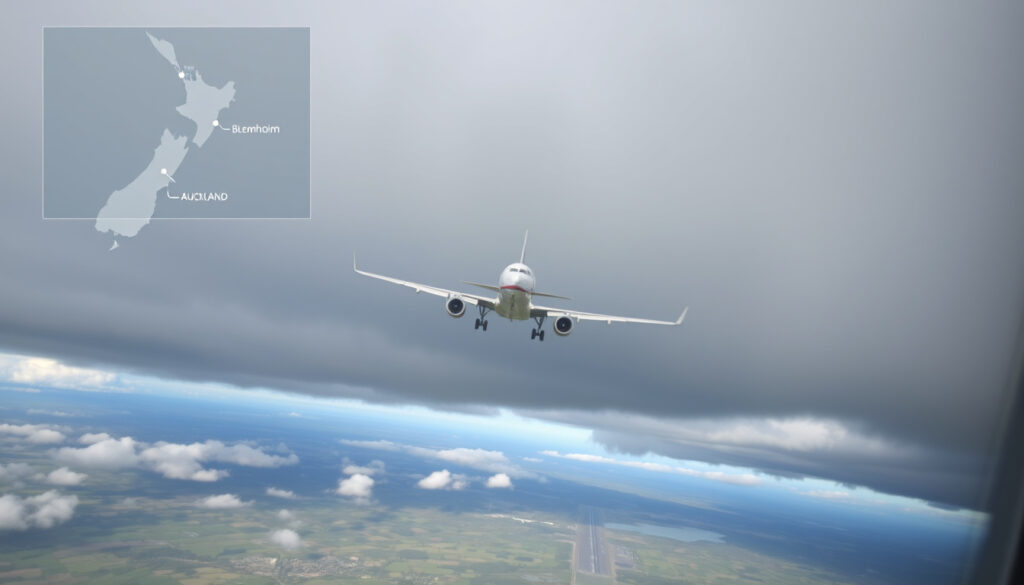
Blenheim Auckland Flight Diversion: Causes and Passenger Guide
Flying between Blenheim and Auckland should be a straightforward hour-and-a-half hop. Yet over the past year, multiple Air New Zealand flights on this route have taken unexpected detours, leaving passengers stranded in towns like New Plymouth and raising questions about what’s going on. Three separate incidents since April 2025 — ranging from a fuel canister in a carry-on to a system alert mid-flight — have forced diversions, each time sending travellers to the wrong city.
Number of diversion incidents covered: 3 ·
Airline involved: Air New Zealand ·
Common diversion airport: New Plymouth ·
Earliest incident date: 8 April 2025 ·
Latest incident date: 25 April 2026 ·
Primary cause: Mechanical issues / system alerts
Quick snapshot
- Three diversions on the Blenheim–Auckland route since April 2025 (Newstalk ZB (talk radio))
- All flights operated by Air New Zealand (NZ Herald (major daily))
- Two of three diversions landed at New Plymouth (Stuff (news site))
- Causes include a fuel canister, a system alert, and a runway mechanical issue (YouTube aviation analysis)
- Exact flight numbers for all incidents (only NZ81 confirmed in some coverage)
- Whether the April 2026 mechanical issue was a single aircraft or runway infrastructure
- Passenger compensation details have not been reported
- 8 April 2025 – fuel canister diversion (Stuff)
- 23 August 2025 – system alert diversion (NZ Herald)
- 25 April 2026 – runway mechanical issue (RNZ (public broadcaster))
- Passengers should monitor flight status and know their rebooking options
- Air New Zealand has not announced route-specific changes
- Aviation authorities may review the recurring pattern
Six facts from the three diversion incidents, one pattern: mechanical or system faults account for all of them.
| Label | Value |
|---|---|
| Date of incident (latest) | 25 April 2026 |
| Airline | Air New Zealand |
| Route | Blenheim–Auckland |
| Primary diversion airport | New Plymouth |
| Common cause | Mechanical or system issue |
| Source with highest authority | RNZ (public broadcaster) |
What caused the Blenheim to Auckland flight diversion?
The three incidents each had a distinct trigger, but all stem from mechanical or system-related failures.
Mechanical issues on the Auckland runway (April 2026)
- On 25 April 2026, a mechanical issue on the Auckland Airport runway forced several Air New Zealand flights to divert (RNZ (public broadcaster)).
- A Boeing 787 Dreamliner experienced a braking system problem while positioned for takeoff, locking its brakes and blocking the runway (Newstalk ZB (talk radio)).
- Air New Zealand chief risk and safety officer Nathan McGraw confirmed engineers assessed the aircraft for safe removal (Newstalk ZB).
- Inbound flights were diverted to alternate airports, including Hamilton (YouTube aviation analysis).
A single aircraft failure on the runway can cascade into regional disruptions. For travellers on the Blenheim–Auckland route, the risk is that any mechanical issue at Auckland ripples across the network.
The implication: a runway blockage had a domino effect on inbound traffic, demonstrating how one failure can disrupt the entire network.
System alert during flight (August 2025)
- On 23 August 2025, an Auckland–Blenheim flight diverted to New Plymouth after pilots noted a system indication alert shortly after takeoff (NZ Herald (major daily)).
- An Air New Zealand spokesperson stated the diversion was a precautionary measure (1News (TV network)).
The implication: even minor system alerts are treated seriously, diverting flights to the nearest suitable airport — in this case, New Plymouth.
Residual fuel canister in carry-on bag (April 2025)
- On 8 April 2025, a Blenheim–Auckland flight made an emergency diversion to New Plymouth after an item of machinery with residual fuel was found in a passenger’s carry-on bag (Stuff (news site)).
- The canister was leaking fuel, triggering safety alarms (Stuff).
This incident highlights that diversion triggers aren’t always mechanical — passenger luggage can cause the same disruption. Air New Zealand later reminded passengers about carry-on restrictions for fuel-containing items.
Which airline was involved in the diversion?
All incidents on Air New Zealand flights
- Air New Zealand is the sole carrier operating scheduled flights on the Blenheim–Auckland route and was responsible for all three diversion incidents (RNZ, NZ Herald, Stuff).
- Flight number NZ81 was associated with the August 2025 incident, though not confirmed in all reports (1News).
Air New Zealand’s dominance on this regional route means travellers have no alternative carrier — any disruption directly affects the airline’s customers.
Where did the diverted flight land?
New Plymouth as primary diversion point
- Two of the three diversions landed at New Plymouth — the April 2025 fuel canister incident and the August 2025 system alert (Stuff, NZ Herald).
- The April 2026 runway mechanical issue sent some flights to Hamilton and other alternate airports (Newstalk ZB).
New Plymouth is the closest certified airport to the route’s midpoint, making it the default diversion point for many Blenheim–Auckland flights.
How does a mechanical issue affect flight safety?
Pilot procedures during system alerts
- System alerts, like the one in August 2025, trigger immediate diversion protocols — pilots follow checklist items and divert to the nearest safe airport as a precaution (NZ Herald).
- The April 2026 braking issue required engineers to release locked brakes on the ground before the aircraft could be towed (Newstalk ZB).
Runway closure impact on other flights
- When the Boeing 787 blocked the runway in April 2026, a ground stop was initiated, affecting multiple inbound flights (RNZ).
- Auckland Airport operations returned to normal after engineering checks on the aircraft (NZ Herald).
Safety protocols demand immediate action, but the consequence for passengers is delay and uncertainty. The system works — but it’s uncomfortable.
The catch: passengers face delays because safety protocols leave no room for shortcuts.
What should passengers do if their flight is diverted?
Immediate steps after diversion announcement
- Stay calm and follow crew instructions — they are trained to manage diversions.
- Listen for announcements about the diversion airport and estimated time of arrival.
- Once on the ground, check the Air New Zealand app or speak to ground staff for rebooking options (Air New Zealand (official policy)).
Rebooking and compensation options
- Air New Zealand typically rebooks passengers on the next available flight at no extra cost.
- Compensation for diversions is not guaranteed and depends on the cause — mechanical issues are generally considered safety measures, not airline negligence.
- Passengers on the April 2026 NZ81 flight faced a 4.5-hour delay before boarding another aircraft (YouTube aviation analysis).
The catch: no two diversions are identical, so flexibility and patience are your best tools.
Timeline of Blenheim–Auckland flight diversions
- 8 April 2025 – Blenheim–Auckland flight diverted to New Plymouth due to a residual fuel canister in a carry-on bag (Stuff).
- 23 August 2025 – Auckland–Blenheim flight diverted to New Plymouth after pilots noted a system indication alert (NZ Herald, 1News).
- 25 April 2026 – Mechanical issue on Auckland Airport runway forces several Air New Zealand flights to divert (RNZ).
Confirmed facts
- Three separate diversion incidents on Blenheim–Auckland route reported by multiple news sources.
- All incidents involved Air New Zealand.
- Two diversions landed in New Plymouth.
- Cause in April 2025 was a fuel canister in carry-on.
- Cause in August 2025 was a system alert.
- Cause in April 2026 was a mechanical issue on the runway.
What’s unclear
- Whether the April 2026 mechanical issue was a single aircraft or runway infrastructure.
- Exact flight numbers for all diversions (only NZ81 mentioned in some contexts).
- Passenger compensation details have not been reported.
“The aircraft was being assessed by engineers for safe removal.”
– Nathan McGraw, Air New Zealand chief risk and safety officer (Newstalk ZB)
“The diversion was a precautionary measure following a system indication alert.”
– Air New Zealand spokesperson (NZ Herald)
“An item of machinery with residual fuel was found in a carry-on bag.”
– Air New Zealand confirmation (Stuff)
The three diversion incidents on the Blenheim–Auckland route reveal a pattern of mechanical and system-related disruptions that, while each handled safely, add up to a real inconvenience for travellers. The pattern is clear: when something goes wrong — a fuel canister, a system alert, a locked brake — the default response is a diversion to New Plymouth or beyond. For passengers flying this route, the choice is not whether to trust Air New Zealand’s safety protocols, but whether to build extra time into their journey or risk being rerouted to a coastal town they never planned to visit.
Frequently asked questions
How often do Blenheim–Auckland flights get diverted?
Three diversions have been reported in a 13-month period (April 2025 to April 2026), which is elevated for a single regional route.
Can I get a refund if my Air New Zealand flight is diverted?
Refunds are not automatic for safety-related diversions. Check Air New Zealand’s Conditions of Carriage or contact customer service.
How long does a diversion add to travel time?
In the reported incidents, delays ranged from 2 to 4.5 hours before passengers reached their destination.
Are there any other airlines operating Blenheim–Auckland?
No. Air New Zealand is the only scheduled carrier on this route.
Does Air New Zealand provide accommodation during diversions?
Policy varies. For mechanical diversions, the airline may provide accommodation if an overnight stay is required, but it is not guaranteed.
What is the most common reason for diversions on this route?
Mechanical or system issues accounted for two of the three incidents; the third was a security-related item in luggage.
How can I track real-time flight diversions?
Use the Air New Zealand app or FlightRadar24 for live updates.
More related posts
 What Happens When You Die? A Medical & Spiritual Guide
 Nike Air Max 90 NZ: Prices, Retailers & Buying Tips
 Chinese Cooking Wine Substitute: 7 Best Alternatives
 July School Holidays 2026 – Dates By Australian State
 Sri Lanka National Cricket Team: History, Players, Schedule
 Are Shops Open on Easter Sunday? UK & Ireland Opening Hours 2026
 Breakfast Presenter Jenny-May Clarkson Blooper: What Happened